

Most site owners know something is off before they can prove it. Pages that used to pull steady traffic have gone quiet. New content takes forever to rank, if it ranks at all. And when you look at the site itself, everything appears fine, which is exactly the problem. Nothing looks broken because the issues are sitting in the details nobody checks.
This is where an audit comes in. It’s not some hand-wavy “audit the site” task, but rather a thorough examination of each factor that affects the page’s understanding, indexing, and click-through rates. Many website owners procrastinate on such a task for its technical nature, but the on-page SEO agency will say the same thing again and again: The vast majority of the work is boring and fixable within one week.
Start With the Pages That Carry Weight
Not every page deserves the same scrutiny, and treating them equally spreads your attention thin. Begin with the pages that bring in traffic or revenue. Homepage, main service pages, top product listings, and whatever blog content is actually earning search visibility.
In both cases, you are assessing one thing at a time as opposed to trying to evaluate all aspects at once. You first start with title tags, then move on to headings, then internal linking, and finally the depth of the content. The element-by-element method uncovers much more as compared to when you perform a simple reading of the elements, since the eye is bound to gloss over what it sees frequently.
It is at this stage that it is important to go back to understanding on-page SEO and its importance before making any attempts at corrections. It may seem simple enough, but most audit mistakes result from a misunderstanding of on-page SEO.
On-Page SEO: What to Fix First
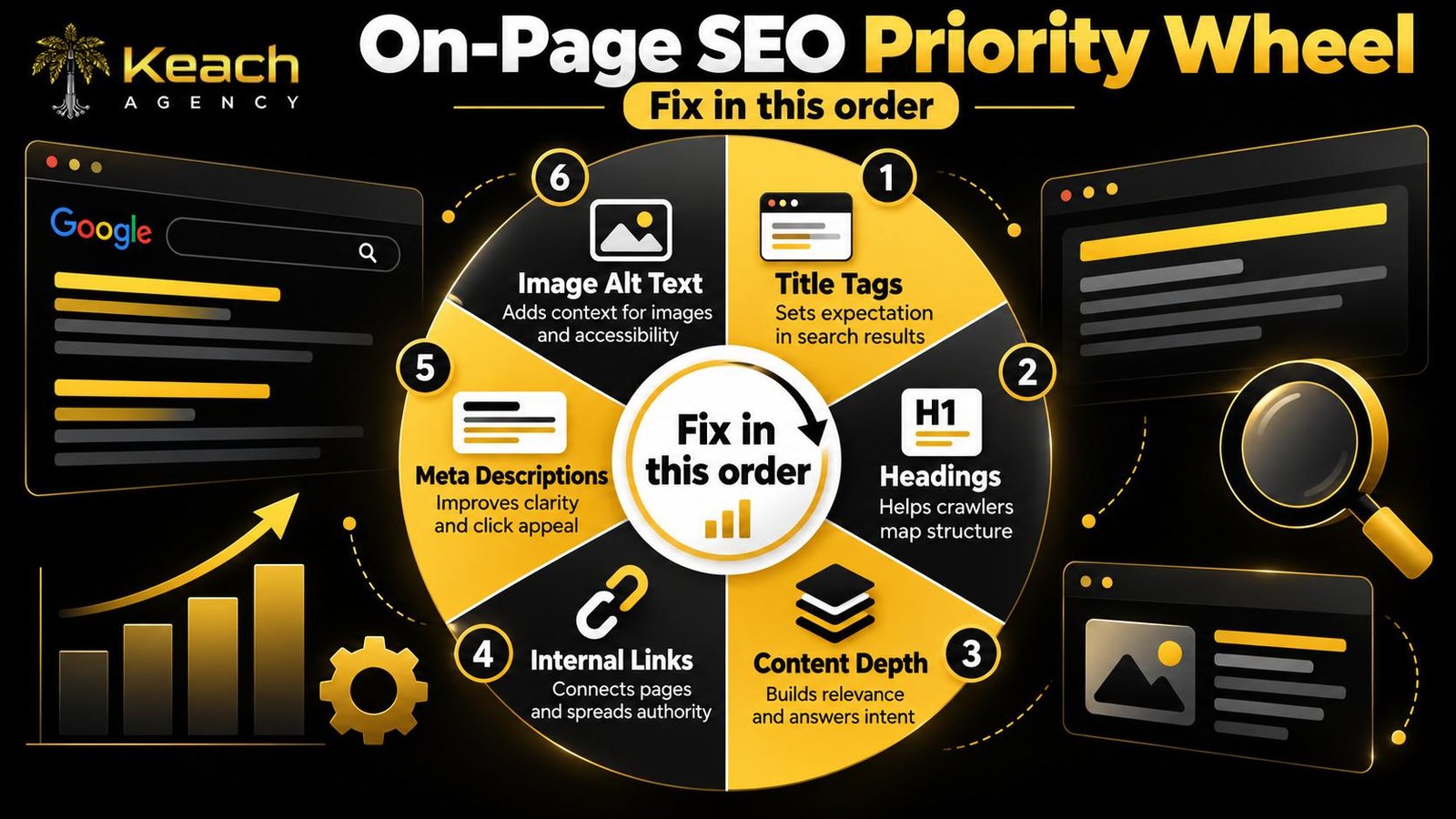
The Elements Worth Checking in Order
Running an on-page SEO audit without a sequence turns into a wandering exercise, and wandering audits are how people spend three weeks finding problems they could have located in an afternoon. The order below moves from highest impact to lowest, which matters when you can’t fix everything at once.
- Title tags: Unique per page, accurate, and written for people rather than keyword counters.
- Headings: One H1 per page, with subheadings that describe each section.
- Content depth: Whether the page fully answers the query it’s targeting.
- Internal links: Body links pointing to related pages rather than sidebar-only navigation.
- Meta descriptions: Written like a reason to click, not a keyword summary.
- Image alt text: Descriptive rather than stuffed.
- URL structure: Readable slugs without unnecessary parameters.
Most sites fail on two or three of these consistently across the whole catalog, which means one template fix can resolve hundreds of pages at once. That’s the part people miss. The problems look enormous until you realize they’re usually the same problem repeated.
Not Sure Where Your Pages Are Falling Short?
Keach Digital Agency runs a full audit and tells you what to fix first.
Where Most Audits Find the Real Problems
The findings tend to repeat across sites, and they’re rarely dramatic. Small oversights, applied everywhere, compound quietly until traffic drops enough for someone to notice.
Titles that were written once and never revisited are the most common. A page about a discontinued product still carries a title that made sense three years ago, and nothing signals to search engines that the content has drifted. Headings suffer the same fate, especially on pages built from a template where every section header says something generic like “Learn More.”
Thin content shows up constantly too, particularly on service pages built to convert rather than inform. A page that lists features without explaining anything rarely ranks, because it doesn’t fully answer what someone searching for that topic actually wants to know.
Internal linking gets skipped more than anything else. Pages sit in isolation, reachable only through navigation, which means crawlers assign them less importance and visitors don’t find them at all. Fixing this costs nothing and produces visible results within weeks, which is rare in SEO work. Building that into a recurring website SEO audit habit is what keeps it from degrading again.
Reading the Findings Without Panicking
A thorough on-page SEO analysis usually surfaces more issues than anyone expected, and the instinct is to fix everything immediately. That approach burns people out and produces scattered results that don’t add up to much.
A better method is grouping findings by template. If forty product pages share the same title format problem, that’s one fix, not forty. If six blog posts have thin content, that’s a content project, not an SEO project. Sorting by root cause rather than by page turns an overwhelming list into a manageable set of tasks.
It also helps to separate issues by impact, since SEO audit factors don’t all carry the same weight. A missing meta description won’t tank rankings, though it may cost you clicks in search results. A page with no internal links pointing to it is a bigger structural problem. Knowing which is which keeps effort pointed where it matters, and it stops you from spending a week on cosmetic fixes while the real problem sits untouched.
When to Bring In Outside Eyes
Plenty of owners can run this process themselves on a small site, and many do it well. The difficulty appears with scale, because consistency is what breaks first. Once you’re managing hundreds of URLs across templates that have changed over the years, keeping standards aligned depends on whoever last touched each page, and that person has usually moved on.
That’s when an on-page SEO agency earns its place, not because the work is beyond reach, but because someone needs to own it continuously rather than in bursts. Audits that happen once a year catch problems late. Ongoing reviews catch them while they’re still cheap to fix.
The other reason outside help matters is perspective. Owners read their own pages the way they intended them, which means gaps that would confuse a stranger stay invisible. A fresh pass catches those faster than any tool, and it’s often the difference between an audit that produces a list and one that produces actual change. Working with an on-page SEO agency also means you’re not the one deciding which findings matter most, which removes a surprising amount of second-guessing from the process.
Getting the new website SEO checklist right from the start saves months of retroactive cleanup for anyone building something new. For sites that have already grown past that stage, regular reviews are what keep the foundation from quietly eroding.
Conclusion: Small Fixes, Compounding Returns
An audit isn’t about finding one dramatic problem. It’s about catching the small ones before they stack up, and then building a habit that keeps them from returning. That’s less exciting than chasing algorithm updates, and it works better.
Keach Digital Agency treats on-page work as ongoing maintenance rather than a one-time project, which is why the on-page SEO agency approach here is less about big reveals and more about steady upkeep. Whether you need a full audit or a steady hand keeping pages current, the goal stays the same. Pages that search engines understand and people actually want to read.
Ready to Know What’s Actually Holding You Back?
Keach Digital Agency audits the details most people miss.
FAQs
How often should an audit be performed?
At least once a year is a good starting point for any website. Quarterly checkups can be performed for websites that frequently publish fresh content and constantly change their templates.
What is the most popular issue detected during an audit?
Absence of a title tag and duplication of title tags and lack of internal linking come second after them. These issues are easy to correct and have a great impact on pages’ performance in search engines.
Do we need special software?
We can use software to speed up the process and to analyze titles and links for more than 100 pages; however, the choice of what content to choose will always be made by a person.
Can I correct all the issues at once?
It is possible to do so, but not very effective. Issues found should be grouped depending on the template and fixed starting with the most important ones.
Will fixing on-page issues improve rankings immediately?
Not immediately. Some changes show results within weeks, particularly internal linking. Others take longer as search engines recrawl and reassess. Consistent maintenance matters more than any single fix.