

Launching a new site feels like the hard part is over. Then you wait for traffic that never quite shows up. The pages exist, the design looks clean, and Google appears to have no opinion about any of it. What’s usually missing isn’t links or budget. It’s the page-level work nobody enjoys doing, the kind that tells search engines what each page is actually about.
A new website lacks all the history to rely upon. It is fresh for crawlers and has no authority built up. Everything will be competing with pages that have been indexed for a few years. Making sure you do everything right at first becomes even more important than with an established website since anything you do wrong will simply be repeated a hundred times down the road.
Start With the Pages That Matter Most
Not all pages need to be given equal consideration when launching. Equal distribution of efforts on all pages will just waste your energy on things that don’t help you achieve anything. Pages worth considering include the pages you need to rank first, meaning the homepage, primary product/service pages, and other content meant for search traffic.
When optimizing these pages, ensure each page is about one idea only. Blending unrelated topics within one URL messes up crawlers and users and is a very common mistake made by new websites trying to fit everything into one page. Focus always trumps diversity.
It is also here that you might want to get a better understanding of what is on-page SEO and why it matters before you make any edits, because then the process becomes clearer. It’s the practice of making one page as clear and useful as possible for search engines and for whoever lands on it, and everything below flows from that idea.
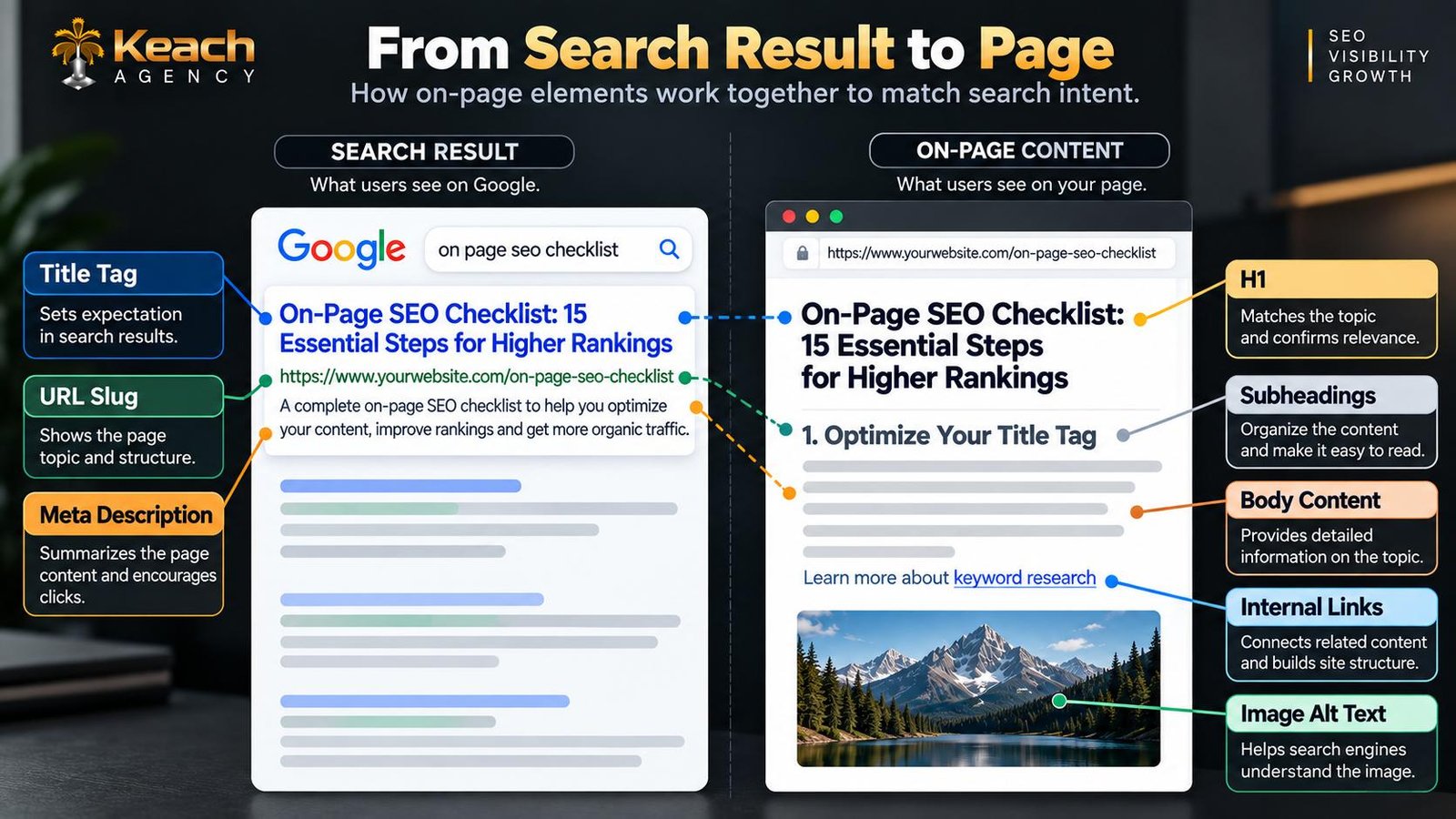
From Search Result to Page: The On-Page SEO Connection
The Essentials Every New Site Needs
Working from a list keeps you from missing something obvious, and for anyone new to this, an on-page SEO checklist for beginners tends to look something like this.
- One unique title tag per page, written for people rather than keyword counters.
- A single H1 that matches what the page is about.
- Subheadings that describe each section so a skimmer can navigate.
- A meta description that reads like a reason to click.
- Descriptive alt text on every meaningful image.
- Internal links pointing to related pages within the body.
- Clean, readable URL slugs without unnecessary parameters.
Most of these take ten minutes per page. That ease is exactly why people skip them. Consistency is the real challenge, and it’s where new sites fall apart once the page count climbs past a few dozen.
Not Sure If Your New Site Is Set Up Right?
Keach Digital Agency reviews the page-level basics and flags what’s missing.
Where New Sites Usually Get It Wrong
A few mistakes show up over and over, and they’re worth naming before they turn into habits.
Titles get stuffed with keywords because it feels productive. A title crammed with search terms reads badly and helps less than people expect. Search engines have gotten better at understanding context, and clarity now outperforms repetition in almost every case.
Internal linking gets skipped on many new sites, leaving every page standing alone. Links between related pages help crawlers understand structure, and they help visitors find their next step. It’s the cheapest improvement available to almost any site, and a website on-page SEO checklist that ignores internal linking is missing the piece with the fastest payoff.
Thin pages cause problems too. A page with two sentences and a contact form rarely ranks, because it doesn’t fully answer anything, and Google has no reason to prefer it over content that does.
Building It Into a Routine
A new website SEO checklist is most useful when it becomes a habit rather than a one-time project. Pages age. Products change. Titles written during launch may stop matching what the page actually says a year later, and nobody notices until traffic drops.
A quarterly pass over your top landing pages catches most drift before it affects anything. Check that titles still reflect the content, that internal links still resolve, and that images still load. It’s dull work with a measurable return, and it takes a fraction of the time that fixing problems after a traffic drop does.
Several on-page SEO techniques pay off consistently across site types. Keeping one clear topic per page. Writing subheadings that tell a skimmer what’s coming. Linking within body text rather than only in a sidebar. Keeping paragraphs short enough to read on a phone. None require special tools, and all of them compound as your site grows.
Getting the new website SEO setup right at launch saves months of retroactive cleanup, since fixing a template issue across fifty pages takes far longer than building it correctly the first time.
When to Bring In Help
For a small site with a handful of pages, handling this yourself is entirely reasonable, and plenty of owners do it well. Difficulty appears with scale. Keeping standards consistent across hundreds of URLs usually depends on whoever last touched a page, and that inconsistency shows up in rankings sooner or later.
Working with an on-page SEO agency makes sense once your site has outgrown casual maintenance, or once you’re planning a migration, a redesign, or a large content push. The value isn’t just the execution. It’s having a structure that keeps every page consistent, which is what separates sites that hold their rankings from ones that slide every time an algorithm update rolls through.
There’s a second reason on-page SEO services earn their keep. Most owners can’t see their own site clearly anymore. They know what the page is supposed to say, so they read it that way, and gaps that would confuse a stranger stay invisible. A fresh set of eyes catches those faster than any tool.
Conclusion: Foundations Before Anything Else
It is not about being tricky; a website ranks because of the effort put into making every page clear, structured, and useful throughout the website’s growth. It will show its consequences soon when it comes to a decrease. On-page SEO by Keach Digital Agency has always been considered a maintenance process, not something that has to be done only once and then be over forever.
Ready to Give Your New Site a Fair Start?
Keach Digital Agency handles the page-level essentials so nothing gets missed.
FAQs
How soon does a newly launched website begin getting ranked?
It differs. Some websites show up in searches after a few weeks, whereas others may take months to show up based on the competition and indexing speed of the website. On-site optimization helps in this regard because it makes the process easier for crawlers.
Is it necessary to write title tags and meta descriptions myself?
If you have enough time, then yes. Writing them yourself ensures that the wording matches your style of speaking to your customers. The most important thing is that each description is unique and describes the page appropriately.
Do internal links matter?
Yes, and they are one of the most underutilized features in any new website. Internal links help crawlers navigate your pages and comprehend their relationships and authority transfer within your website, rather than having your pages work in silos.
How often should I audit old pages?
Quarterly audits of your top landing pages will suffice for any average site. Any pages with seasonality or changes in products need to be audited monthly because outdated information could be killing your conversion even before your rankings start dropping.
Do I need to change my website structure to solve on-page SEO problems?
No, in most cases you don’t need that. The issues in on-page SEO are usually page-level problems, not overall site architecture problems.