

Meta descriptions find themselves in a rather bizarre spot when it comes to search marketing. Meta descriptions do not impact the rankings of pages but can influence the decision of whether or not a user clicks through on an already-ranked page. The irony here is that a page may be placed high in the rankings for a keyword but will receive less traffic due to the poor meta description beneath.
The disconnect between ranking and clicking can become the point from which traffic is leaked by sites. Updating meta descriptions does not involve the creation of new content or any technical modifications. It is one of the simplest tasks to accomplish; however, this task requires knowledge of what will really work.
Why Meta Descriptions Still Matter
Search engines have gotten better at generating descriptions on their own, which has convinced plenty of site owners that writing them manually is a waste of time. That conclusion is only half right. Search engines will pull text from your page when they can’t find a description or when they think a better one exists, but that scraped text rarely reads well as a standalone pitch.
When a description is well written, search engines tend to use it, because it accurately signals what the page delivers. When it’s thin, generic, or missing, they substitute something pulled from the page body, and the result usually looks like a random excerpt rather than a reason to click.
There’s also a compounding effect most people miss. Strong descriptions lift click-through rates, and higher click-through rates signal to search engines that the page is relevant, which can improve rankings over time. Descriptions don’t rank pages directly, but they influence the behavior that does.
Descriptions Getting Scrolled Past in Search Results?
Keach Digital Agency rewrites them for clicks, not just compliance.
What Makes a Description Actually Work
A description has one job. Give the reader a reason to click instead of scrolling past. That’s a simple goal, but it requires balancing several things at once, and getting the balance wrong produces descriptions that technically describe the page without ever convincing anyone to visit it.
Specificity is the first ingredient. A description that says “learn more about our services” tells the reader nothing. One that names the specific problem or outcome the page addresses gives them a reason to care. Vague descriptions are the most common failure, and they’re also the easiest to fix.
Tone matters just as much. On-page SEO services that write descriptions for clients tend to focus heavily on matching the tone of the search query itself. Someone typing a question expects an answer, while someone searching for a product expects a reason to buy. The description should feel like a natural response to whatever brought the reader there.
Length is another factor, though it’s often misunderstood. The question of ideal meta description length comes down to what actually shows in results. Descriptions that run too long get truncated, which means the most important phrase needs to appear early. Descriptions that are too short waste the space that could be doing more work.
The Anatomy of a Strong Meta Description
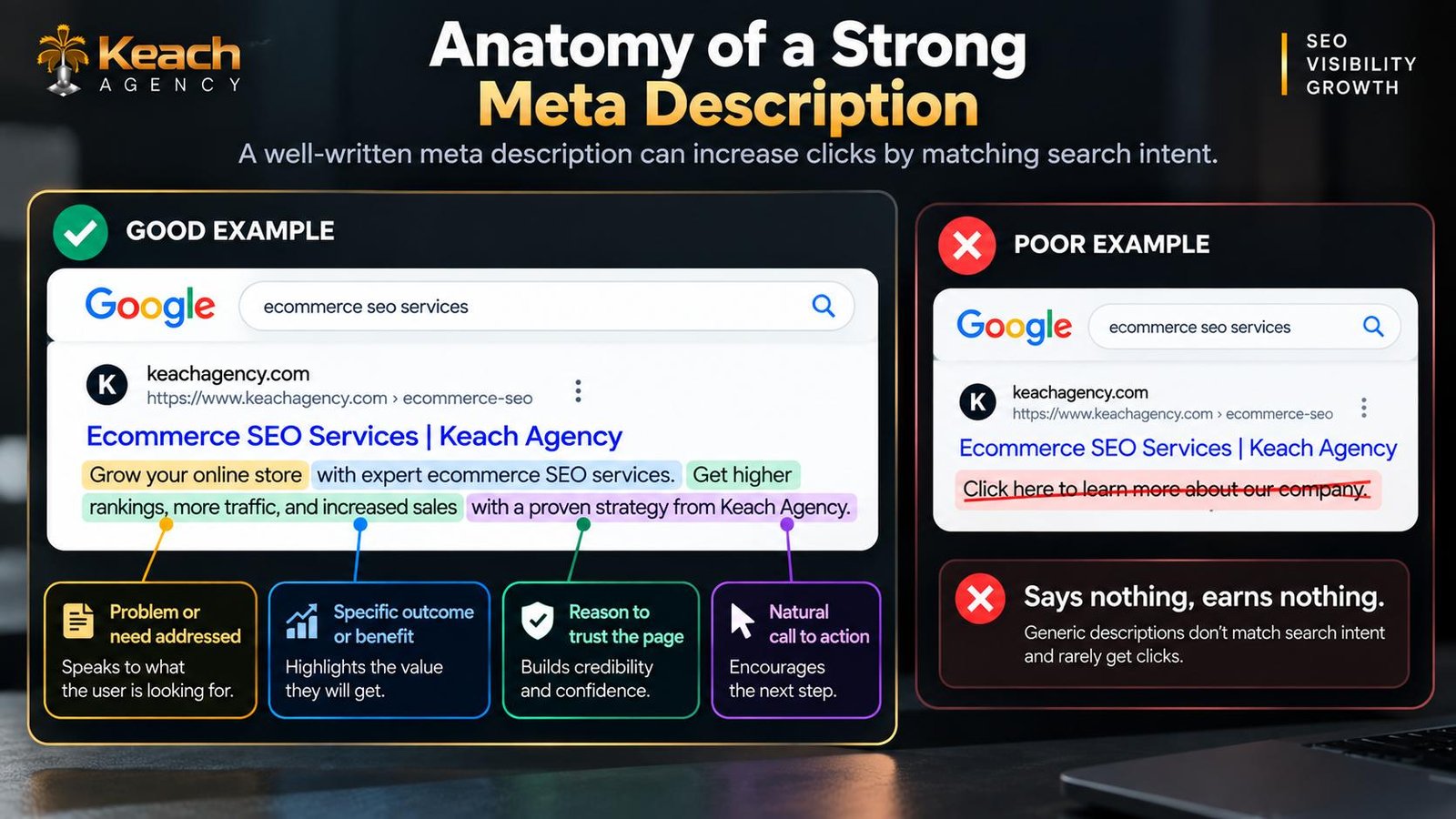
How to Write Meta Descriptions That Earn the Click
Learning how to write meta descriptions starts with understanding what the reader sees when your page appears in results. They’ve already read the title. The description is what confirms or eliminates their interest, and it has only a few seconds to do that work.
Leading with the benefit rather than the feature tends to perform better, because readers skim for outcomes rather than descriptions. If the page explains a service, the description should say what changes for the reader rather than what the service technically includes. If the page solves a problem, the description should name the problem in the reader’s own words.
Ending with a soft call to action works well in most cases, but only when it fits naturally. A description that reads like an advertisement performs worse than one that reads like useful information, because readers have learned to skip past anything that sounds like a pitch. Writing in plain language and letting the value speak for itself almost always outperforms adding pressure.
Common Mistakes That Quietly Cost Traffic
Several common issues appear in all websites regardless of their size, but there is one common feature about them. All these issues lower CTR but do not generate any errors, thus allowing them to exist for many years.
- Duplicate descriptions for several pages, making all results look identical.
- Keyword stuffing, making content sound unnatural and low quality.
- Generic language that might be used for describing any website.
- Descriptions that promise something the page doesn’t actually deliver.
- Missing descriptions, which leaves search engines to write them instead.
Duplicate descriptions are the most damaging of that list, especially on sites with many similar pages. When every product or service page carries the same description, search engines have no way to distinguish between them, and users see identical results and stop clicking.
Where Title Tags and Descriptions Work Together
Descriptions never appear alone in a search result. They sit directly under the title, and the two elements have to work as a pair rather than as separate pieces. A strong title with a weak description wastes half the opportunity, and the same is true in reverse.
That’s why understanding how to optimize title tags for SEO makes description work easier, since the title defines what the description needs to add rather than repeat. If the title already names the topic clearly, the description can focus on the outcome or the specifics. If the title is broad, the description carries more of the explanation.
The pair should read as a complete thought from top to bottom. Someone scanning quickly should understand what the page covers and why it’s worth visiting without needing to read anything else on the page.
Testing Descriptions Without Breaking What Works
There is some risk involved in rewriting descriptions on a live website, though it is less than the risks associated with any other modifications since descriptions do not have an effect on ranking. It is harder to determine whether the new modification is better than the old one.
Therefore, the best way to make such changes is to introduce description updates incrementally and see how it affects click-throughs for a couple of weeks before continuing. Some changes can be immediately beneficial, while some may take longer, and others may even backfire in the process of analysis. This process becomes more structured with the help of an experienced on-page SEO services provider.
Conclusion: Small Text, Real Impact
A meta description is roughly one sentence of writing, but it sits between your page and every reader who finds it in search. Getting it right lifts traffic from pages that are already ranking, and it does so without touching content, structure, or anything technical.
Keach Digital Agency treats description work as part of a larger on-page system rather than an isolated task. Whether you need descriptions rewritten across an entire site or help understanding what your current ones are missing, the goal stays the same. Text that reads clearly, earns clicks, and gives your pages a fair chance in the results.
Ready to Fix the Descriptions Nobody Clicks On?
Keach Digital Agency rewrites them with readers and rankings in mind.
FAQs
Do meta descriptions impact rankings?
Not really. Meta descriptions do not have any direct influence on rankings, but a high click-through rate can lead to improved rankings over time since the click-through rate indicates relevance. In other words, the content does not impact rankings, but the actions it causes do.
How long should a meta description be?
The exact number is not known. It is recommended that important parts be placed at the beginning so that the information is preserved even if it gets truncated. Long descriptions get truncated, while short descriptions do not use the full available space.
Can the same meta description be used for different web pages?
No. If you use the same meta description on different pages, then the result will look exactly alike. Neither search engines nor users will be able to distinguish between them.
Will they use the description I write for sure?
They do not have to do that always. They can pick some text right off the page if they find it better for the search term. Descriptions which are well-written and relevant to the content of the page will be used as is.
How often should descriptions be reviewed?
Once a year for the most part, or when click-throughs begin decreasing on key pages. Quarterly review of top landing pages is enough.