
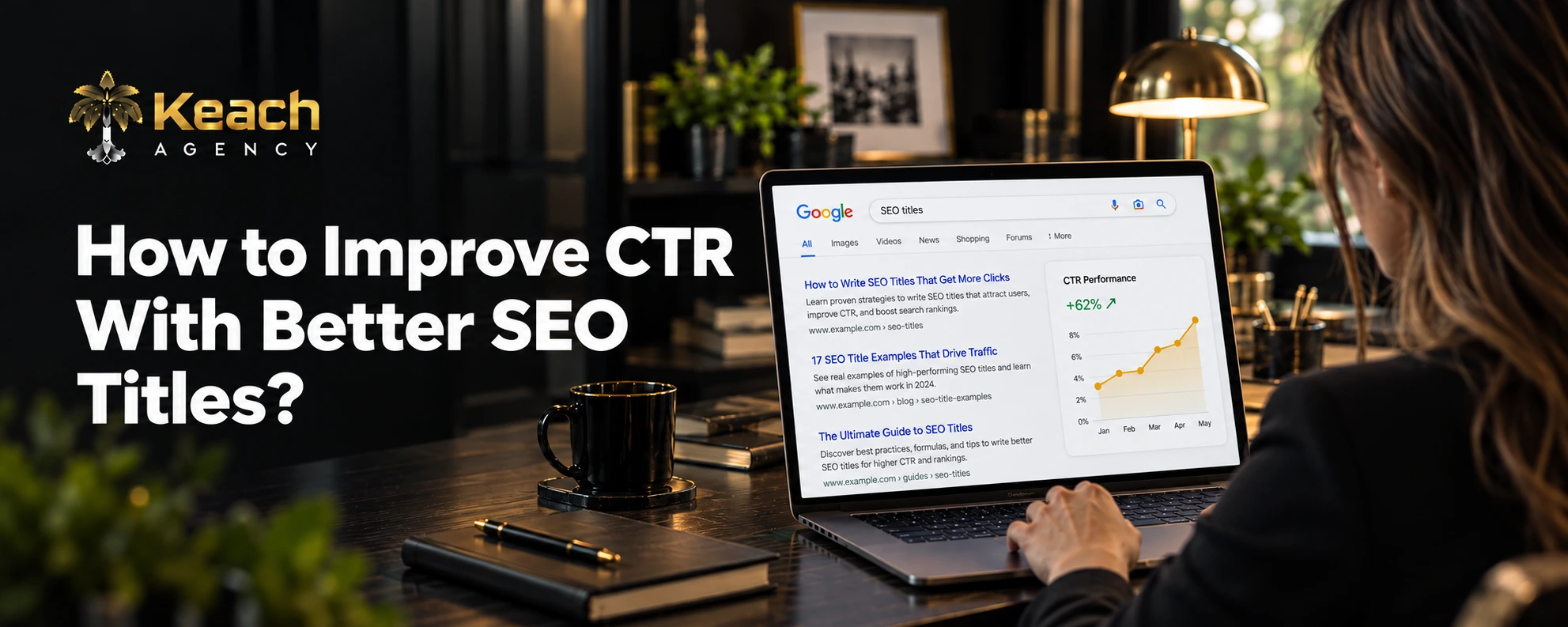
You ranked. Page one, position four. You should be celebrating, right? Except the traffic isn’t there. Impressions keep climbing in Search Console, and the clicks stay flat, which means people are seeing your result and choosing someone else’s. That stings more than not ranking at all, honestly. At least when you’re on page three, you know why nobody’s clicking.
This is the part of SEO that doesn’t get talked about enough. Getting to page one is half the job. Getting clicked is the other half, and it’s a completely different skill. A title that ranks well and a title that earns clicks aren’t always the same title, and figuring out that gap is how you improve organic CTR without writing a single new page.
Why Rankings Alone Don’t Pay the Bills
Search engines don’t send traffic. They send impressions. Impressions become traffic only when a real human looks at your result and decides it’s worth their click. That decision happens in about half a second, and it’s based almost entirely on two things. The title and the description underneath it.
So when your ranking is fine, and your traffic isn’t, the problem lives in the gap between those two. Something about your listing isn’t winning the click. Could be the phrasing. Could be that a competitor’s title promises something yours doesn’t. Could be that your title is technically correct and emotionally dead.
The fix is rarely a rewrite of the whole page. It’s almost always a rewrite of the title. And that’s good news, because titles are the cheapest thing to test on any site. You change one line of text. You wait a few weeks. You check the numbers. That’s it.
Ranking Fine but Nobody’s Clicking?
Keach Digital Agency rewrites titles for clicks, not just compliance.
What Makes a Title Get Clicked
A title that earns clicks does a few things at once. It tells the searcher what the page is about. It tells them why it’s worth their time. And it does it in fewer characters than most people think they have room for.
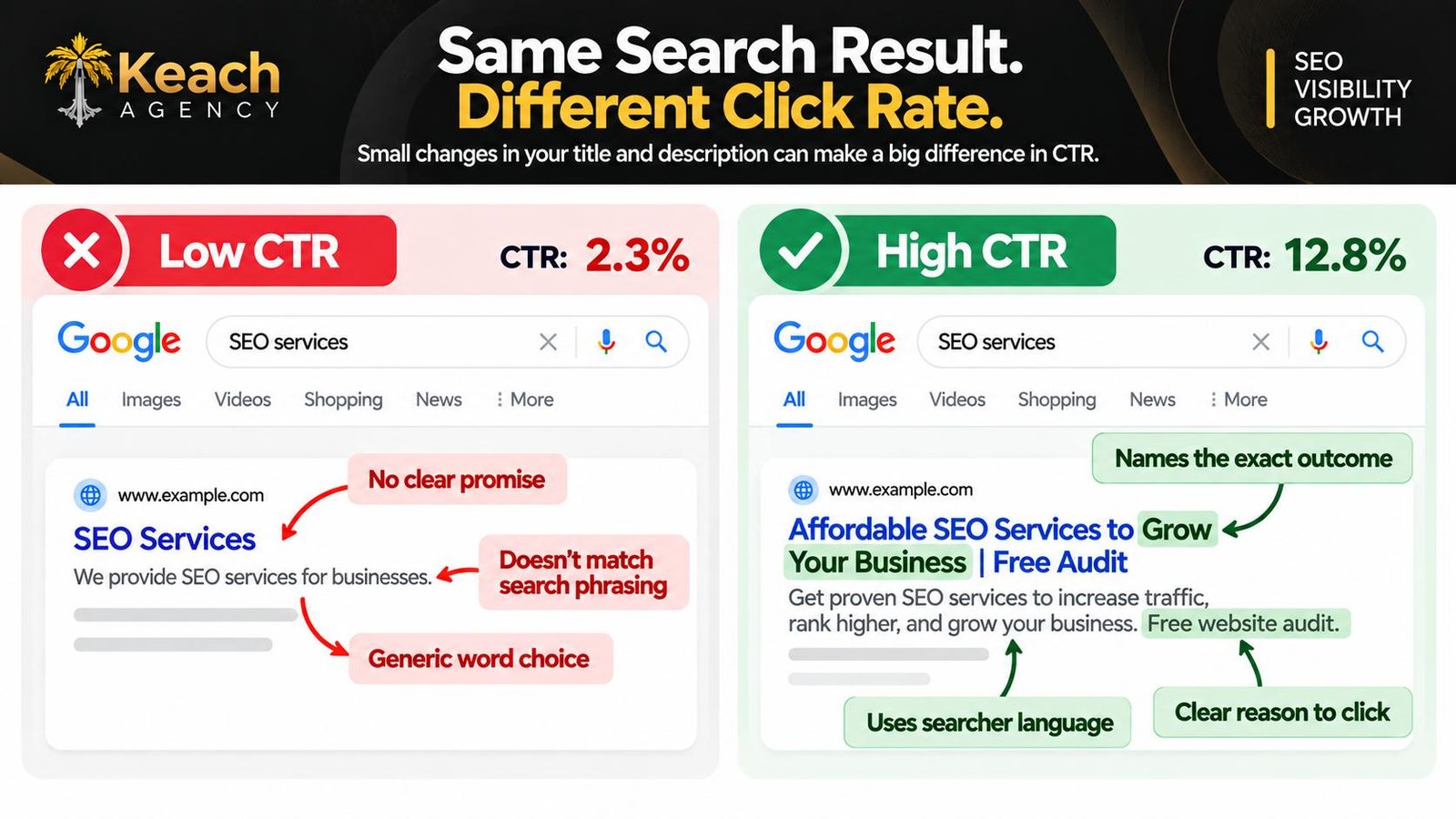
Specific beats clever every single time. “How to Lower Your Electric Bill” outperforms “Smart Energy Tips for Modern Homes” because the first one answers a question the searcher is already asking. The second one sounds nice and says nothing.
Numbers help when they’re real. “7 Ways to Reduce Shipping Costs” gives the searcher a clear expectation of what they’ll get. “Ways to Reduce Shipping Costs” is vague enough to get skipped. Same page, different promise.
And the searcher’s own words matter more than yours. If people search “how to remove hard water stains” and your title says “Tackling Mineral Deposits in Your Bathroom,” you’re speaking a different language than your audience. Match their phrasing. It’s a small change with a big effect.
Low CTR vs. High CTR: What Makes the Difference?
SEO Title Optimization Without Overthinking It
SEO title optimization does not mean the insertion of keywords into it. It is not topical already, and people understand it. Nowadays, a title is something that will fit a person when they see search engine results rather than a computer that sees the code.
To begin with, identify the query that the user made. If they asked some questions, provide answers. If they compared options, show them which option is better. If they were searching for the name of some product, then say something about this product. In this way, you create a continuation of his search request, not some advertising message that yells at him.
The length of a title is not so important, but the position matters much. All that you need to write must be at the beginning of the title. If the title will become too long and will be cut off, the main phrase must be put at the beginning. After that, go to the brand name and all other information because you can afford to lose it.
Testing can help. Just not on a massive scale like an entire website, but rather one page at a time. Tweak the title, see what happens to the CTR in Search Console after a couple of weeks. If it has increased, you have succeeded. Otherwise, continue tweaking until it improves.
The Relationship Between Titles and Search Intent
Here’s something that trips people up. A title can be well-written and still fail because it doesn’t match the intent behind the query. Someone searching “best CRM for small business” wants a comparison. If your title says “What Is a CRM? Complete Guide,” it’s technically related but completely wrong for the moment.
Getting this right means understanding what kind of result the searcher is expecting before you write the title. Are they learning? Comparing? Ready to buy? The title should match. That’s why understanding how to optimize content for search intent comes before title work itself. Intent first, then phrasing. Not the other way around.
This is also why a title that performs well for one keyword can flop for another. Same page, same content, different intent. The title has to shift with it.
Where CTR Optimization Goes Beyond the Title
Titles do most of the work, but they don’t do all of it. The description underneath shapes whether the click actually happens, and a weak description can undo a strong title.
The URL matters too, though less than people assume. A clean, readable URL reinforces trust. A messy one with parameters and numbers scattered through it doesn’t necessarily kill the click, but it doesn’t help either.
Rich snippets impact the equation as well. When your competitors have star ratings, prices, and FAQ drop-down menus on their listing while you are displaying just a simple blue link, their listings occupy more visual space, and yours goes unnoticed. Rich snippets alone are not a way to increase the click-through rate, but they alter the content the search engine shows and impact the attention it receives.
It is important to note that cooperation with a professional team of on-page SEO services professionals allows handling all this stuff at once instead of doing everything one by one. All the factors we talked about above influence one metric; therefore, working on them separately leads to different outcomes.
Measuring What’s Working
The only real measure of a title is what it does to organic click-through rate over time. Not how good it sounds when you read it out loud. Not how clever it is. Just the number in Search Console.
That’s why improving search CTR requires patience more than anything. Changes take a few weeks to show up in the data, and the noise in the early days can be misleading. A title that looks better on day one might be worse on day thirty. A title that looks worse might slowly climb. Only the trend matters.
And if a change is successful, it is likely to be sustainable as well. A title with a higher click-through rate is likely to gain better rankings over time, as it is interpreted by the algorithm as indicating greater relevance.
Conclusion: The Last Mile of SEO
The real challenge comes next: how to make the click. The titles decide whether that happens, meaning that they are among the most powerful elements you can change on your website. Small changes, guaranteed results, and no new content needed.
CTR optimization is one piece of the greater on-page SEO puzzle at Keach Digital Agency. The titles, descriptions, structure, and intent are all intertwined elements, and the on-page SEO services offered here are implemented as a cohesive approach rather than four distinct endeavors. Whether it’s a single underperforming page or a multitude of titles you need to rework, the aim remains the same. Make it to page one and then get the click.
Ready to Turn Impressions Into Actual Visitors?
Keach Digital Agency writes titles that earn the click.
FAQs
How will I determine if my poor CTR is caused by the title?
If your page ranks well and impressions continue to increase but not the clicks, then the problem is with the title and description. This is the only thing the searcher sees before they decide to click the link or not.
How much time must elapse until I determine if my title improved click-throughs?
It needs at least 3-4 weeks. The data is erratic in the short term, and time must be given to determine whether there was a real trend or a mere anomaly.
Can a good title fix a poor ranking?
No. While a good title can boost the CTR for a well-ranking page, a bad ranking cannot be fixed by a good title.
And how about descriptions and their impact on click-through rates?
Yes. The description is placed directly after the title and affects the click decision. A good title with a poor description tends to perform worse than an average title with an interesting description.
Am I supposed to test all titles on all pages then?
Begin with those pages which have a lot of impressions and a low number of clicks. That’s where your highest ROI is.