

You’ve done the keyword research. You’ve written the post. You’ve hit publish and waited for the traffic to roll in. And then… nothing. Or worse, a little bit of traffic that bounces in three seconds and never comes back. If that sounds familiar, the problem probably isn’t your writing. It’s that you wrote the right words for the wrong reason.
Search intent is the thing most content creators skip past because it sounds like marketing jargon. It’s not. It’s actually the simplest idea in all of SEO. When someone types something into Google, they want a specific thing. Your job is to figure out what that thing is and give it to them. That’s it. That’s the whole concept. But somehow, most content misses it. And that’s what we’re going to fix.
What Search Intent Actually Means
Let’s start with a plain example. Someone searches “how to make sourdough.” What do they want? A recipe. Steps. Times. Temperatures. Maybe a video. They don’t want a history of bread. They don’t want a story about your trip to San Francisco. They want the recipe, and they want it fast.
Now imagine someone searches “best sourdough starter.” Different intent entirely. They’re not looking to learn anything. They’re comparing options. They want reviews, prices, brand names. If you serve them a tutorial, they’ll bounce. If you serve them a comparison list, they’ll stay and probably buy.
Same topic. Two completely different pages needed. That’s search intent. The words on the page matter less than whether the page delivers what the searcher was actually after.
Writing Content That Nobody Sticks Around to Read?
Keach Digital Agency maps search intent before a single word gets written.
The Four Types You Need to Know
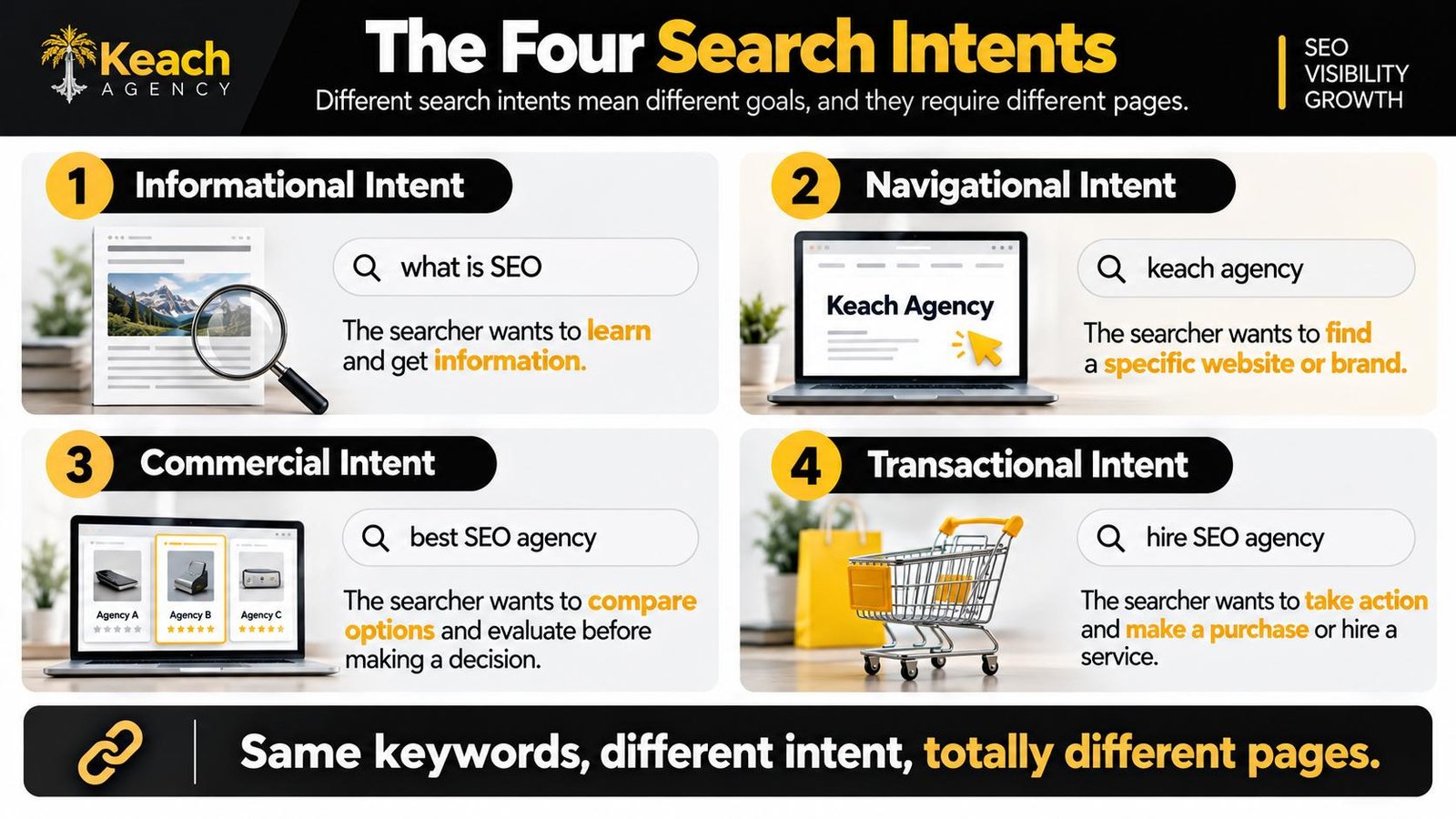
Search intent usually falls into one of four buckets, and knowing which one you’re targeting changes how you write everything.
Informational
People want to learn something. “What is compound interest?” “How do solar panels work?” These searches want clarity, depth, and no sales pitch.
Navigational
People want a specific site or brand. “Amazon login.” “Keach Agency contact.” These are almost impossible to rank for unless you’re the brand in question.
Commercial
People are researching before buying. “Best CRM for small business.” “Keach Agency reviews.” These want comparisons, breakdowns, and honest guidance.
Transactional
People are ready to buy. “Buy Nike Air Max 90.” “Hire content writer near me.” These want a product page, a booking form, or a way to purchase immediately.
Getting the type wrong is the single most common reason a well-written page never ranks. Google’s algorithm is very good at matching intent. If your page doesn’t match, no amount of optimization saves it.
Search Intent: Understanding What Users Want
How to Figure Out What People Are Actually Looking For
Here’s the practical part. Before you write anything, look at the search results for your target keyword. Not to copy them, but to see what type of content is already ranking. That tells you what Google has decided the intent is.
If the top ten results are all how-to guides, write a how-to guide. If they’re all product comparison lists, write a comparison. If they’re all landing pages, build a landing page. Fighting the pattern rarely works, because Google isn’t going to suddenly change its mind about what people want just because you wrote something different.
Now check out the “related searches” and the “people also ask” sections. This gives you the search terms that actual users type, as opposed to the ones that you assume they might be typing. This is where most of the content strategy takes place. Actual questions, actual phrasing, actual intent.
This is where working with seasoned on-page SEO services makes a huge difference. Not because it’s a difficult task, but because recognizing patterns takes time. Someone who has done it before across numerous websites would recognize intent problems in minutes, while a novice might take weeks to figure it out.
The Difference Between Optimizing for Keywords and Optimizing for People
There’s a reason keyword-first content stopped working the way it used to. Search engines got smarter. They stopped matching words and started matching meaning. So when someone optimizes a page purely around a phrase without thinking about what the reader wants, the page looks technically fine and ranks poorly anyway.
Content optimized for search intent means writing for the person on the other side of the screen. It means covering the exact question they asked, in the depth they need, in the format they expect. The keyword lives inside that. It’s not the point. It’s the entry point.
And the funny thing is, when you get intent right, the keyword work almost takes care of itself. You naturally include the right terms because you’re answering the actual question. You naturally structure the page in a way Google can read because you’re thinking about how a person would navigate it. The optimization stops being forced.
Search Intent Optimization in Practice
There are just a few habits you need to develop to optimize for true search intent.
First, read the top-ranking pages on any given search term before you draft the outline for your page. This is not to steal anything, but to learn what you need to do to get your content to the same level.
Next, follow the format. If the intent requires a list, make it a list. If the intent calls for a lengthy guide, go ahead and make one. Format matching is one of the most underutilized methods for closing the gap between your page and those which rank.
Third, you must answer the question within the first 100 words. Do not worry about making your SEO-friendly answer in these first hundred words; answer the question itself.
Finally, do not pad. Write as many words as you need to answer the question, but only the words needed. Pages that add padding to reach the word count are transparent both to the reader and to Google.
Where SEO Content Optimization Goes Wrong
The mistakes tend to repeat across sites, and once you’ve seen them a few times, they’re easy to spot. Writing one page for multiple intents is probably the most common. A page that tries to explain, compare, and sell all at once ends up doing none of it well. Splitting that into separate pages is almost always the better move.
Mismatches of tone are yet another issue. A neutral and supportive tone is required for informational queries, while a confident and clear tone works well for transactional queries. Both would feel like a mismatch if done improperly, even for those who cannot explain how.
Finally, the classic problem is writing for the keyword rather than for the reader. The keywords in search intent are not magic words that must be put into your writing but are hints for what actual people need.
Conclusion: Give People What They Asked For
Search intent isn’t complicated. It’s just easy to skip. And when you skip it, the writing suffers, the rankings suffer, and the traffic that does show up doesn’t stick around. The intent comes from the start when creating content at Keach Digital Agency; hence, there is no need for any post hoc adjustment due to any mismatch. Regardless of whether you have just created your website or are reviving an old one that has never ranked before, the end aim will always remain the same. Creating pages that answer the actual query of the searchers.
Ready to Stop Writing for Keywords and Start Writing for People?
Keach Digital Agency builds content around real search intent.
FAQs
How do I find out the search intent behind a certain keyword?
Simply look at the pages ranking for that term. The type of format being used gives you a hint about the intent Google is attributing to the query.
Is it possible to address multiple search intents on one page?
Sure, it is. But it won’t be very effective. One page per one intent is almost always going to outperform the page trying to serve more than one search intent.
Can search intent vary over time?
Yes, it can. What kind of expectations your visitors might have with regard to your keywords changes with time as well; that’s why re-checking your keywords’ intent at least once a year can make sense, especially for outdated pages.
Why is my page ranked, but not converting?
Because of the wrong search intent, sometimes you can see that you’re ranked for the query, but your page doesn’t move your readers towards the conversion point.
Why is the format so important for search intent?
Because there are guides, comparisons, product pages, and lists, each of which is designed for a different purpose; matching the format Google is rewarding is the most effective way.