
Every few years, someone publishes a think piece declaring WordPress dead. And every time, the numbers tell a completely different story.
In 2026, WordPress still powers over 43% of all websites on the internet. That’s not a niche platform clinging to relevance; that’s a dominant piece of global digital infrastructure. And behind every WordPress site, there’s a developer (or a team of them) making it work. If you’ve been wondering whether a career in WordPress development still makes sense, or why businesses continue to invest in WordPress talent, the answer is more interesting than you might expect.
Want to hire a skilled WordPress developer for your next project?
Ready to Build Your Website? Get in touch with our team today
WordPress Market Share: The Numbers Don’t Lie
Let’s start with the data, because it’s genuinely striking.
WordPress market share has remained consistently strong despite the rise of website builders like Wix, Squarespace, and Webflow. What these newer platforms offer in simplicity, they sacrifice in flexibility and ownership. WordPress, by contrast, gives developers complete control over code, hosting, database structure, and customization depth.
That combination of scale and control is why the ecosystem never stalled. Thousands of new WordPress sites launch every single day. Plugins, themes, headless implementations, and WooCommerce stores each of these needs someone who understands the platform at a technical level. Demand for that expertise hasn’t dried up. If anything, as WordPress has grown more complex with block-based development and full site editing, the skill ceiling has risen, creating more specialized (and higher-paying) niches within the developer community.
Why Businesses Use WordPress And Keep Using It
There’s a persistent misconception that WordPress is “just a blogging platform.” Businesses figured out a long time ago that this isn’t true.
Why businesses use WordPress comes down to a few things that are genuinely hard to replicate elsewhere:
Ownership and portability. When a company builds on WordPress, they own their data, their site, and their codebase. There’s no vendor lock-in. If they want to switch hosting providers tomorrow, they can.
An ecosystem that actually works. Over 60,000 plugins exist in the official repository alone. Need appointment booking? There’s a plugin. E-commerce? WooCommerce handles billions in transactions annually. Membership sites, LMS platforms, job boards, the ecosystem has matured to cover almost every use case a business could have.
Lower total cost of ownership. Enterprise CMS platforms can cost hundreds of thousands of dollars in licensing fees. WordPress, being open-source, doesn’t. That’s a real consideration for mid-sized companies with tight budgets and ambitious digital goals.
Developer availability. This one is practical: it’s easier to find WordPress developers than developers fluent in proprietary systems. That talent availability makes it a lower-risk technology bet for businesses building long-term.
The Skills That Are Actually in Demand Right Now
Not all WordPress development looks the same in 2026. The platform has evolved substantially, and so has the type of developer businesses are looking for.
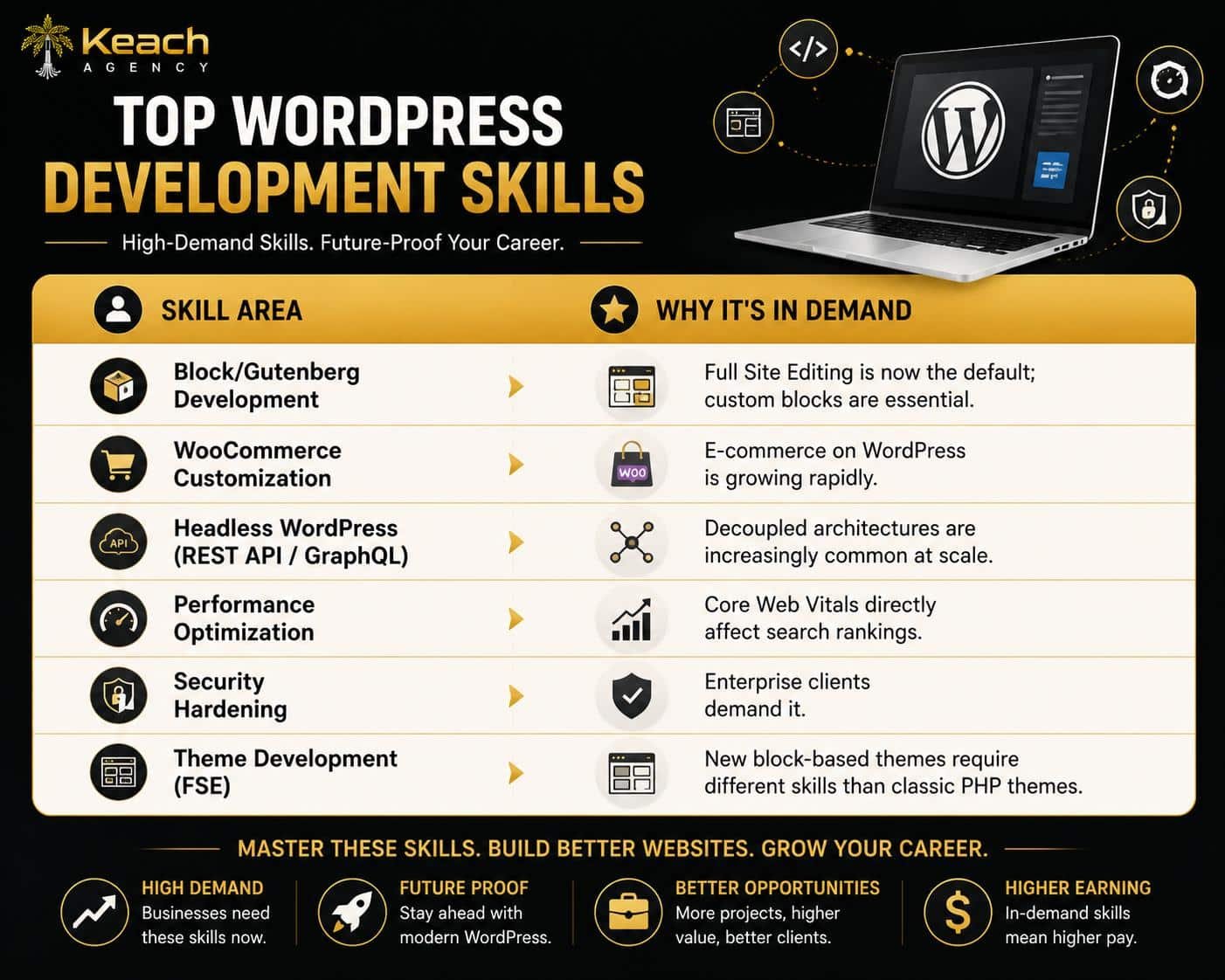
The developers thriving right now aren’t generalists who slap together pre-made themes. They understand PHP deeply, they’re comfortable with JavaScript (React knowledge helps significantly for Gutenberg), and they can work within modern DevOps workflows, version control, staging environments, CI/CD pipelines.
Looking to upskill in WordPress development?
Explore our curated resources and developer courses
The Future of WordPress: More Opportunity, Not Less
Here’s where the conversation gets genuinely interesting.
The future of WordPress isn’t about survival, it’s about expansion into territory that would have seemed ambitious five years ago. Automattic (the company behind WordPress.com and a major contributor to WordPress.org) has continued investing heavily in the platform. The Gutenberg project is ongoing, with Phase 3 and Phase 4 focused on collaboration and multilingual features, respectively.
Headless WordPress has become a serious architectural choice for companies that want a modern JavaScript frontend (Next.js, Nuxt, Astro) with a familiar content management backend. This means WordPress developers who can navigate both worlds the traditional PHP stack and modern frontend frameworks are exceptionally valuable right now.
There’s also the enterprise angle. WordPress VIP, the platform’s enterprise offering, counts Fortune 500 companies among its clients. That’s not the image most people have of WordPress, but it’s the reality. Serving that tier of client requires sophisticated developers who can handle high-traffic architecture, custom integrations, and security at scale.
None of this is going away. If anything, the market is bifurcating: simpler sites moving to no-code tools, and complex, high-stakes WordPress implementations requiring more skilled developers than ever.
Freelance vs. Agency vs. In-House: Where Are the Jobs?
WordPress developers demand spans every employment model, which is part of what makes it an attractive career path.
Freelancers often find a steady flow of project work through platforms like Upwork and Toptal, but increasingly through direct client relationships built over the years. Agencies focused on WordPress work tend to have strong pipelines because businesses need ongoing support, not just initial builds. And in-house roles exist at companies running complex WordPress infrastructure media companies, e-commerce brands, and SaaS businesses that built their marketing sites on WordPress and need someone to own it internally.
The salary data reflects the specialization premium. Entry-level WordPress developers might earn $50,000–$70,000 annually, while senior developers with WooCommerce or headless expertise regularly command $100,000–$150,000 or more, particularly in markets like the US, UK, and Australia.
What This Means If You’re Hiring or Building a Career
If you’re on the hiring side, the challenge isn’t that WordPress developers don’t exist it’s finding ones with the right depth. Generic WordPress skills are commoditized. But developers who combine strong PHP fundamentals, JavaScript proficiency, and experience with modern tooling (Composer, webpack, Docker) are genuinely competitive hires who can make a real difference.
If you’re building a career: WordPress isn’t the “easy path” anymore. The platform’s complexity has grown alongside its capabilities. That’s actually good news it means the ceiling is higher, and the developers who put in the work to develop great technical skills are well-compensated and consistently employed.
Ready to build something great on WordPress?
Connect with Keach Digital Agency’s expert WordPress development team.
Conclusion
Built on deep expertise in WordPress and digital strategy, Keach Digital Agency helps businesses build, optimize, and scale their WordPress presence from custom development to ongoing support. If your next project needs a team that genuinely knows the platform, we’re here.
FAQ
Is WordPress development still a good career in 2026?
Yes, absolutely. WordPress development remains a strong career choice in 2026 because the platform continues to power a massive share of the web, and businesses consistently need skilled developers to build, maintain, and scale their sites. As WordPress has grown more complex with block-based development and headless architectures, the demand for technically skilled developers has increased rather than decreased.
Why do so many businesses still choose WordPress over other platforms?
Businesses choose WordPress for several practical reasons: complete data ownership, a massive plugin ecosystem, lower licensing costs compared to proprietary CMS platforms, and access to a large global pool of developers. It’s also highly flexible from simple blogs to enterprise-level e-commerce which makes it a low-risk, long-term technology investment.
What WordPress skills are most in demand right now?
In 2026, the most in-demand WordPress skills include Gutenberg/block development, WooCommerce customization, headless WordPress implementations using the REST API or GraphQL, performance optimization, and security hardening. Developers with React knowledge and experience in modern DevOps workflows are particularly competitive.
Is WordPress losing market share to website builders like Wix or Squarespace?
WordPress has maintained strong market share despite competition from website builders. While tools like Wix and Squarespace have attracted users who need simple sites quickly, WordPress continues to dominate among businesses that require flexibility, scalability, and full ownership of their digital infrastructure. The two markets largely serve different needs.
How much do WordPress developers earn in 2026?
WordPress developer salaries vary significantly by experience and specialization. Entry-level developers typically earn between $50,000 and $70,000 annually, while senior developers particularly those with expertise in WooCommerce, headless WordPress, or enterprise-level performance can command $100,000 to $150,000 or more depending on location and employment model.