
You have probably visited a WordPress site already today without giving it a second thought. The article that showed up when you searched for something, the small business you looked up before deciding whether to call, the freelancer’s portfolio that made you think these people actually know what they are doing.
WordPress runs a quietly enormous slice of the internet, and behind every one of those experiences is a person making decisions about how the whole thing should work.
Ask what a WordPress developer actually does, though, and most people wave vaguely at a screen and say something about coding. Which is about as descriptive as saying a chef heats things up. Technically not wrong, tells you nothing useful.
WordPress developer roles are broader and more consequential than the job title implies. If you are a business owner trying to understand what your site actually needs, or why it keeps frustrating you, getting clear on what this role genuinely covers will save you from some expensive confusion.
What does a WordPress developer do for your business?
Keach Agency helps businesses get results with developer support.
What WordPress Developer Roles Actually Involve
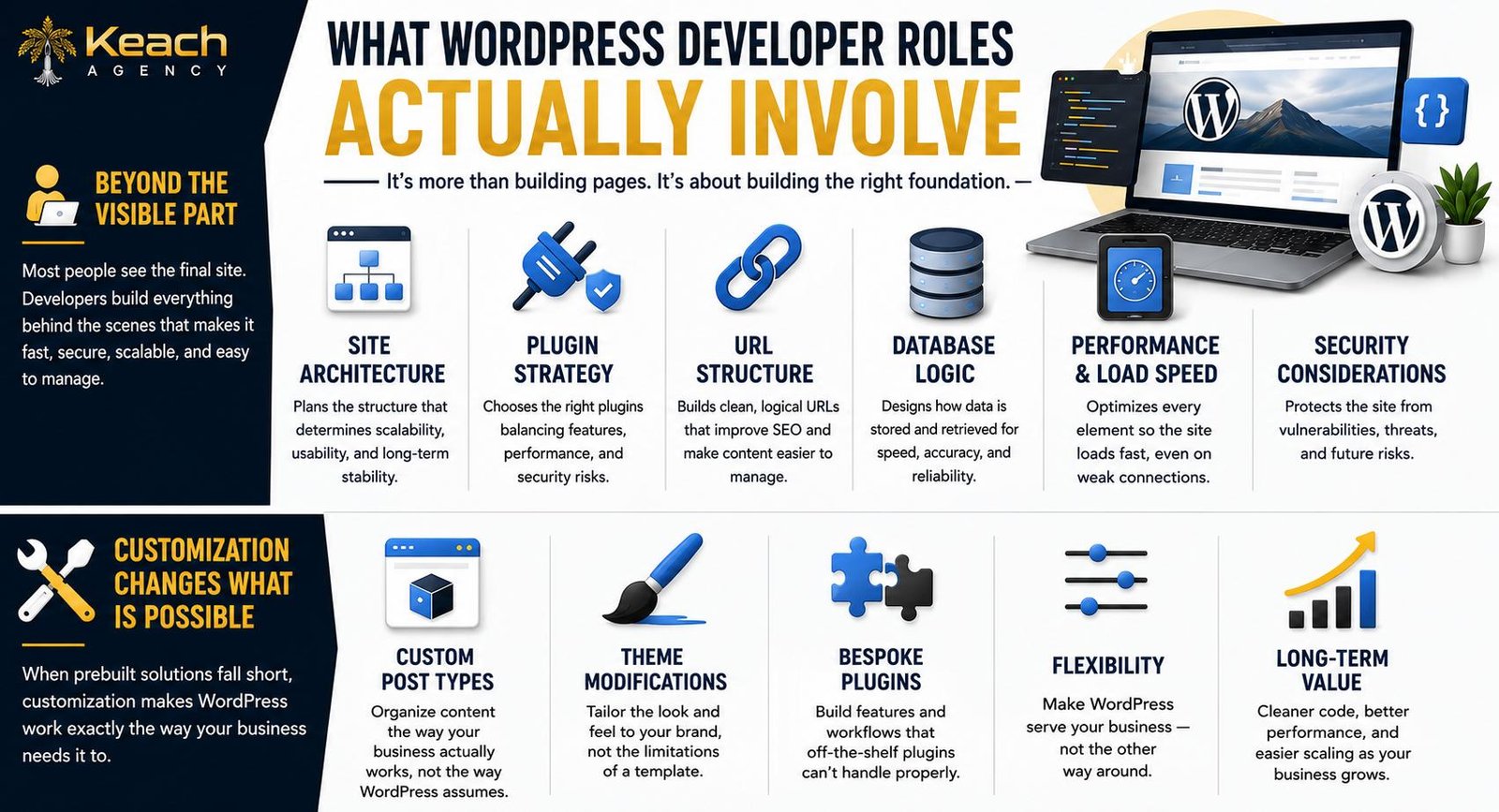
Most people picture WordPress website development as someone assembling a site. Picking a theme, setting up pages, and making things look like the approved design. That is part of the picture. It is also the most visible and least interesting part of a role that goes considerably deeper.
The actual duties of a WordPress developer during a build involve a series of decisions that most clients never see. Site architecture that determines how the whole thing holds up and scales over time. Plugin choices that balance what the site needs to do against the performance drag and security exposure every added piece of software creates.
URL structure, database logic, navigation hierarchy, and how everything loads on a phone with a weak signal at seven in the morning. Every one of those calls either sets things up well or quietly creates problems; nobody connects back to those early decisions until sorting them out becomes expensive.
Customization Changes What Is Possible
The out-of-the-box version of WordPress takes businesses further than most people expect. A solid theme, the right plugins, and someone who has done this before. It works well right up until the moment the business needs something that sits just outside what the prebuilt ecosystem handles cleanly. At that point, every workaround starts creating its own complications.
WordPress customization services fill that gap. Custom post types that reflect how the business actually organizes content, rather than how a default install assumes. Theme modifications that make the site feel like the brand rather than the template it sits on. Bespoke plugins that handle the specific workflow, nothing off the shelf addresses properly.
The ability to make the platform serve the business requirement rather than asking the business to adapt around the platform is genuinely one of the most valuable things a skilled developer brings. It is also what separates real WordPress website development from someone who mostly installs things and calls it done.
The Duties That Rarely Get Mentioned
A site that loads slowly loses people before they have formed any impression of the business behind it. Fast enough that nobody consciously notices is the actual target, and reaching it takes real work. Image optimization, caching configuration, database efficiency, code quality, and the hosting environment itself.
These are core duties of a WordPress developer, not post-launch housekeeping. They directly affect where the site ranks and whether real visitors stick around long enough to see what the business is offering.
WordPress website development that treats performance as something to address later tends to produce sites that technically exist and quietly underperform in every way that shows up in actual numbers.
Security Is a Commitment Not a Checkbox
WordPress powers enough of the internet that it stays permanently in the crosshairs. The duties of a WordPress developer include owning the security layer on an ongoing basis. Regular updates to core and plugins, backup systems that have been actually tested, monitoring for unusual activity, and the ability to respond quickly when something goes sideways. Businesses that assume security was handled at launch tend to find out otherwise at the worst possible moment.
Is your WordPress site doing the job your business needs?
Close the gap between what you have and what you need.
What Good Development Produces
There is a version of WordPress website development that amounts to fitting prebuilt parts together and hoping the result holds up. And there is the version that starts from what the business genuinely needs and builds toward that from the beginning.
WordPress customization services done properly produce the second version. Design that reflects the actual brand rather than the template it came from. Functionality built around the workflows the business uses every day. Integrations that connect the site to the tools already running the operation.
The difference between a site working for the business and a business quietly working around its site’s limitations sounds like a small thing until you have been on the wrong side of it for a while.
The SEO Foundation Most People Miss
One of the most undervalued parts of WordPress developer roles is the technical SEO layer that good development builds in without announcing itself. Clean code that search engines can read without obstacles. Heading structure that communicates content hierarchy properly. Schema markup that gives Google context before a human reads the page. Site architecture that distributes authority sensibly rather than fragmenting it across pages that quietly work against each other.
This does not replace an actual SEO strategy. What it does is create an environment that lets one work properly. WordPress website development done with this in mind from day one produces sites that are easier to rank, easier to maintain, and easier to build on over time than sites where the technical foundation was treated as someone else’s problem after the fact.
Ready to work with a WordPress developer?
Keach Agency connects with WordPress website development expertise.
FAQs
What are the main WordPress developer roles?
Frontend, backend, and full stack cover the core territory. Day-to-day, the duties of a WordPress developer span theme and plugin development, performance work, security management, and maintenance. The exact scope depends on the project rather than a fixed list.
What do WordPress developers actually do every day?
Writing and testing code, managing updates and security, configuring themes and plugins, and working through what clients need built or fixed. WordPress customization services take up a significant chunk of ongoing work because the gap between what a site currently does and what a business needs it to do is almost always bigger than it looks at first glance.
Why do WordPress customization services matter?
No template fits any real business perfectly, and that gap shows up quickly. It appears in performance, in conversion rates, and in how frustrating the site is to manage over time. WordPress customization services close that gap deliberately rather than leaving the business to work around it indefinitely.
How does WordPress website development affect SEO?
More directly than most people realize. Clean code, fast loading, sensible architecture, and correct schema all feed into rankings in ways that compound. WordPress website development done with SEO considered from the beginning creates a foundation that supports the strategy rather than fighting against it.
When does a business actually need a WordPress developer?
When the site needs functionality plugins that cannot be handled cleanly, when performance requires proper optimization, or when security needs consistent professional attention. Most growing businesses reach this point faster than they expect once they start pushing against what prebuilt tools were designed to do.