
For years, digital marketing conversations followed a familiar pattern.
SEO lived in one corner. Social media lived in another. Each had its own tactics, tools, and experts. Rankings were treated as a search problem. Engagement was framed as a social problem.
That separation made sense once. It makes far less sense today.
People no longer move through the internet in clean, predictable paths. They discover brands through posts, verify them through search, revisit them through videos, then search again before making decisions. Visibility is shaped by a mix of platforms, behaviors, and repeated exposure.
This shift is where the idea of a search social strategy enters the picture.
Not as a buzzword, but as a response to how people actually consume information now. Search behavior and social behavior constantly influence one another. Treating them as disconnected channels often limits results.
Struggling to connect your content across platforms?
A SEO strategy that aligns with the audience is the solution.
Why the Traditional Separation Started Failing
Older marketing models assumed users behaved linearly. Someone searched for a term. Clicked on a website. Made a decision. Modern behavior is messier.
A person might first see a brand on social media. Later, they search for reviews. Then watch related content. Then search again using different queries. The final action reflects a chain of interactions rather than a single discovery moment.
A rigid social media strategy that ignores search intent misses part of this journey. Likewise, an SEO strategy that ignores social signals overlooks how awareness and curiosity are often triggered. Visibility rarely begins and ends in one place anymore.
Defining Search Social Strategy in Practical Terms
A search social strategy is not simply “doing SEO and social media at the same time.”
It reflects alignment
Content planning, keyword research, messaging, and distribution operate with shared intent. Instead of treating search engines and social platforms as isolated ecosystems, the strategy recognizes that users flow between them constantly.
- Search influences what people look for.
- Social influences what people notice and remember.
AT Keach Digital Agency, when these forces reinforce one another, digital presence becomes more cohesive and more persuasive.
How Search Behavior Connects With Social Exposure
Search queries often originate from earlier exposure.
Someone sees a concept on social media. Later, they search for explanations. A video introduces an idea. A search deepens understanding. A post sparks interest. A search confirms credibility.
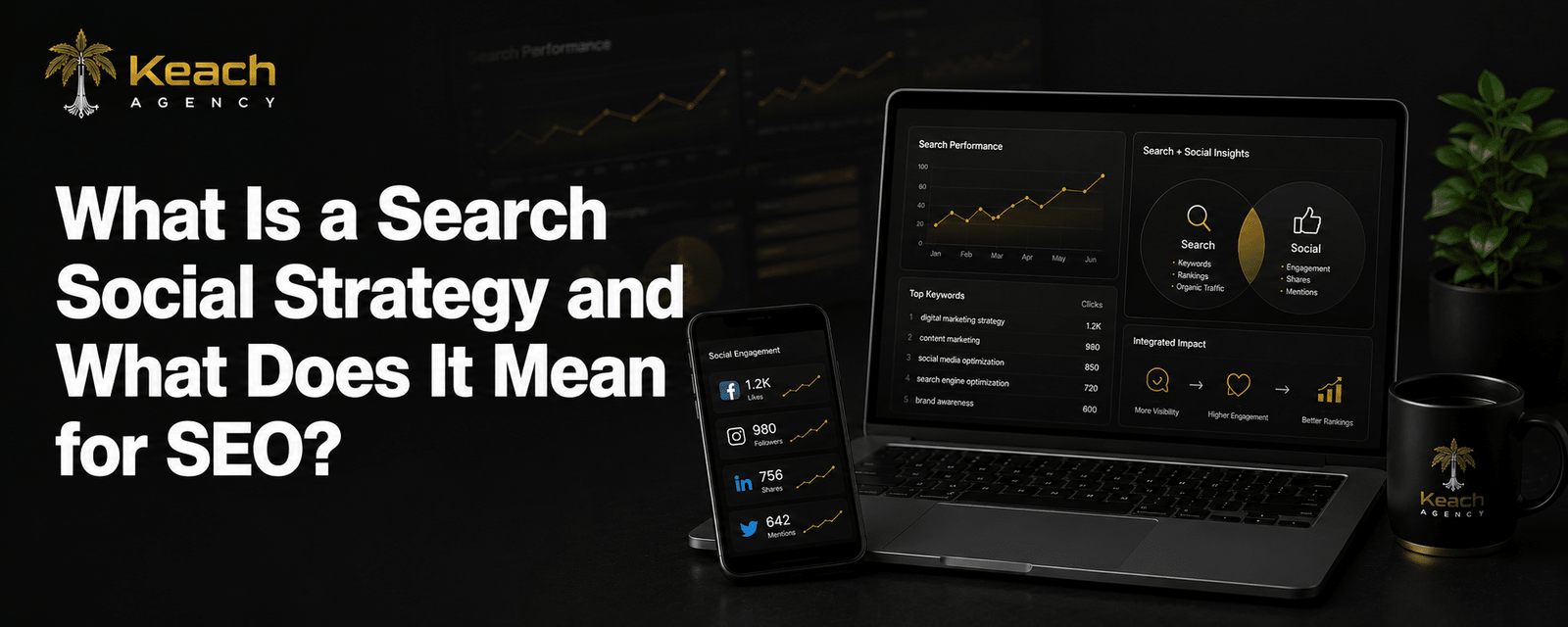
This interaction loop is central to search and social marketing.
Content does not exist only to rank or only to engage. It participates in a broader discovery cycle. Visibility compounds when users repeatedly encounter consistent themes across channels.
Fragmentation weakens recall. Consistency strengthens trust.
Why SEO Alone No Longer Controls Visibility
SEO remains critical, but attention patterns have changed.
Users spend substantial time within social platforms that also function as search environments. People search inside video apps, community platforms, and social networks. Discovery happens beyond traditional search engines.
A modern SEO strategy must account for this reality, and that’s exactly what we do at Keach Agency.
Search visibility is influenced not only by technical optimization, but also by brand familiarity. Familiarity is often shaped by social content, discussions, and repeated exposure.
Search and social are not competitors. They operate as parallel influence systems.
Content Strategy Under a Search Social Model
Under a search social strategy, content decisions follow a broader logic.
Instead of asking “Will this rank?” or “Will this go viral?”, the question becomes more layered.
- Does this topic match search curiosity?
- Can this message travel well socially?
- Does this piece reinforce brand themes?
Effective search and social marketing depend on overlap between discoverability and shareability. Some formats perform better in search contexts, while others thrive socially. Strategic alignment avoids random content production. This is precisely why intentional social posting habits matter more than posting frequency alone.
Seeing traffic but weak engagement signals?
Keach Agency helps create social media strategy.
The Role of Social Signals in Search Perception
Search engines do not rank pages based purely on social metrics.
Yet social dynamics influence search behavior indirectly. Widely discussed topics generate queries. Recognizable brands attract clicks. Familiar names feel safer to users scanning results.
This psychological layer matters.
A brand frequently encountered through strong social media marketing services often enjoys higher trust when appearing in search results. Recognition shapes perceived credibility before a page even loads.
Visibility is technical. Trust is behavioral.
Why Fragmented Strategies Create Inefficiency
Disconnected marketing systems frequently duplicate effort.
SEO teams research topics already explored by social teams. Social teams produce content misaligned with search demand. Messaging drifts across platforms, weakening brand coherence.
A unified SEO strategy and social media strategy reduce these gaps. Coordination improves efficiency, clarity, and cumulative visibility.
Measuring Impact Across Search and Social
Evaluation models also evolve under this framework.
Success cannot be judged solely by rankings or solely by engagement metrics. Traffic patterns, brand queries, retention behavior, and cross platform interactions provide richer signals.
Integrated search and social marketing reveals how audiences move, not just how pages perform.
Digital behavior keeps evolving.
Strategies must evolve with it. A search social strategy does not replace SEO or social media. It reframes them. When search logic and social dynamics operate together, visibility becomes more natural, more stable, and more reflective of how people actually navigate the web.
Attention is no longer channel bound. Neither should strategy be. Understanding how evolving search algorithms are reshaping keyword and content decisions is part of building this kind of future-ready visibility strategy.
Want search and social channels to reinforce each other?
Reflects real user behavior with a strategy.
FAQs
What exactly is a search social strategy?
A search social strategy aligns SEO and social media efforts so that content, messaging, and discovery paths support each other. It reflects how users move between platforms rather than treating channels separately.
How does social media influence SEO if rankings are algorithmic?
Social activity can shape visibility indirectly by driving awareness, generating searches, increasing brand recognition, and influencing click behavior. These factors affect how users interact with search results.
Is search and social marketing relevant for small businesses?
Yes. Smaller brands often benefit significantly from integrated visibility because recognition and trust play major roles in attracting attention across competitive digital environments.
Does every piece of content need to serve both search and social?
Not necessarily. Different formats serve different roles. The key is strategic coordination so that content collectively strengthens overall presence rather than operating randomly.
Why are traditional SEO strategies becoming less effective alone?
User discovery patterns have diversified. People search and explore across multiple platforms. SEO remains vital, but visibility now depends on broader digital interactions.