

Think about this: you see a stylish chair at a friend’s house, snap a photo, and instantly find the same chair online. Or spot a jacket you like and discover exactly where to buy it, all without typing a single word. That’s the power of visual search.
In 2026, people are searching with their eyes as much as their fingers. Platforms like Google Lens and Pinterest let users find products, ideas, and inspiration just by pointing their camera. For businesses, this means images are no longer just decoration; they’re the gateway to discovery, traffic, and sales.
This shift fits into a much bigger change happening across search as a whole. If you want to understand how visual search fits alongside niche SEO and modern discovery, our guide on navigating the evolving landscape of search in 2026 breaks it down in detail.
In this blog, we’ll explore why visual search is exploding, how Google Lens and Pinterest rank images, and practical tips to optimize your visuals so your products get seen and bought.
Want Visual Search Keywords For Your Niche?
We can generate excellent lists for you.
The Future Of Search Is Visual, And It’s Already Here
If voice search made searching feel like a conversation, visual search has made it effortless.
People don’t have to type, guess keywords, or describe what they’re looking for anymore; they just point their camera.
Platforms like Pinterest and Google Lens have completely changed how people discover new products. From fashion and furniture to skincare and food, shoppers are using their cameras to find what they want before they ever open Google Search.
This mirrors what we’re seeing on social platforms, too. Discovery is becoming visual-first everywhere, whether it’s search engines or feeds. We’ve seen the same pattern in how the TikTok algorithm prioritizes visual discovery and short-form content.
People are literally shopping with their eyes and their cameras.
This tells us exactly where search is heading:
- Less typing.
- Less guessing.
- More seeing.
And if your brand isn’t optimized for visual discovery yet, you’re missing out on thousands of high-intent customers every single month.
Keach’s Digital Marketing Services are especially crafted for your strong online presence, along with proper guidance on every step across various platforms.
Why Visual Search Is Exploding In 2026
Three major shifts have made visual search mainstream:
1. AI can now recognize almost anything
Google Lens can instantly identify:
- Clothes.
- Plants.
- Cars.
- Skin products.
- Home decor.
- Brands.
- Ingredients.
…all in seconds.
AI vision has gotten shockingly accurate.
2. Pinterest has become a visual search engine
Pinterest users search with images, not keywords. That means your product photos need SEO just as much as your blog posts do. This is very similar to how visual signals affect reach on platforms like Instagram. Our breakdown of how the Instagram algorithm handles discoverability explains this overlap well.
Moreover, check out our Instagram Advertising Services for further elaboration on how to handle Instagram.
3. Visual shoppers convert faster
Visual search users are 4x more likely to buy because they already know:
- What they want.
- What it looks like.
- Their style.
- Their intent.
They’re not browsing, they’re buying.
Google Lens: The New Product Search Engine
More people now use Google Lens to find products than ever before.
They use it to:
- Identify clothing and find similar options.
- Look up ingredients or nutrients.
- Find home decor online.
- Translate text instantly.
- Compare prices in-store.
- Read reviews on the spot.
If someone uses Lens on a product similar to yours, Google shows the closest visual match. Which means: your images must be optimized to become the “answer.”
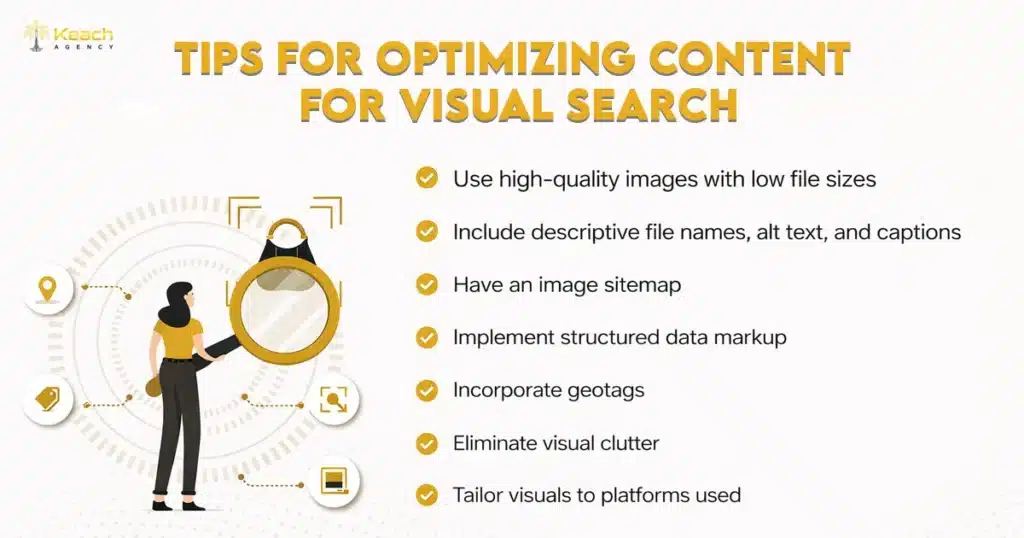
How to Optimize for Google Lens (Visual SEO)
1. Use high-quality, multi-angle images
Google’s AI looks for:
- Patterns.
- Textures.
- Colors.
- Logos.
- Shapes.
- Edges.
Poor-quality images won’t rank.
2. Add keyword-rich alt text
Alt text tells Google exactly what’s in your image.
Example:
“Blue oversized cotton shirt for women with loose-fit sleeves” instead of “Blue shirt.”
Describe the image like you’re describing it to a friend.
3. Rename your image files
No more IMG_2038848.jpg. Use descriptive file names:
blue-oversized-women-cotton-shirt.jpg.
It helps Google connect your images to relevant searches.
4. Add product schema
Google Lens prioritizes images with:
- Price.
- Brand.
- Availability.
- Ratings.
- Product type.
Schema markup links your images directly to this information.
5. Use shoppable images
Platforms like Shopify, WooCommerce, and Pinterest now support:
- Product tagging.
- Visual search metadata.
- Direct checkout options.
Shoppable images = higher conversions.
Pinterest: The Hidden Visual Search Engine You Can’t Ignore
Pinterest isn’t just a social app, it’s a visual discovery platform.
Pinterest Lens analyzes:
- Lifestyle images.
- Flat layouts.
- Fashion boards.
- Home decor setups.
- Color palettes.
- Product photos.
Then it recommends similar items.
Pinterest is a goldmine for:
- Fashion.
- Home decor.
- DIY + crafts.
- Beauty & skincare.
- Food.
- Travel.
- Art & design.
If your brand fits in any of these categories, Pinterest can send massive traffic.
Need Pinterest Or Google Lens Optimization?
Tell us your product type and we’ll build your strategy.
How to Optimize for Pinterest Visual Search
1. Use tall, high-quality vertical images
- Best size: 1000×1500.
- Clean, bright pins perform best.
2. Add keyword-rich titles and descriptions
Pinterest is half image search, half traditional SEO.
Use long-tail keywords like:
“Minimalist white bedroom decor ideas.”
Instead of,
“Bedroom design.”
3. Pin consistently
Pinterest rewards brands that publish regularly, not randomly.
4. Add text overlays
Pins with text often outperform plain images because they:
- Grab attention.
- Explain the content.
- Improve SEO inside Pinterest.
5. Use product catalogs + Rich Pins
These allow users to:
- See prices.
- Check stock.
- Visit your site.
- Buy instantly.
Perfect for e-commerce growth.
Visual Search: What’s Coming Next
Visual search is only getting bigger.
Expect:
- Smarter AI recommendations.
- Instant “shop this entire look” features.
- More camera-first shopping tools.
- Nearly fully visual SERPs.
- Higher competition in e-commerce.
- Brands investing heavily in images + SEO.
Voice search will also continue blending with visual tools, especially in smart homes and assistants. If that space matters to your brand, our guide on optimizing for voice search in the smart home era is worth reading next.
Want A Full Visual SEO Content Plan?
We can map out perfect content for your niche.
FAQs
1. What is visual search optimization?
It’s the process of optimizing your images so platforms like Google Lens and Pinterest can understand them and recommend them.
2. Do I really need high-quality images?
Yes. Visual search AI relies on clear, detailed images to identify products accurately.
3. Is Pinterest basically a search engine?
Yes. It uses both keywords and image recognition to rank content.
4. Can visual search increase sales?
Absolutely. Visual search users convert much faster because they already know what they want.
5. Is visual search important for every business?
It’s essential for e-commerce, fashion, home decor, lifestyle, beauty, and any product-based brand.