
In 2026, customers aren’t just searching “near me” anymore; they’re searching inside micro-locations, small communities, and hyperlocal platforms that feel personal and familiar.
The future of search is becoming deeply location-aware. And any business that still relies only on Google Maps is already falling behind.
Hyperlocal SEO is no longer about ranking across a city. It’s about owning:
- Specific streets.
- Neighborhood clusters.
- Local marketplaces.
- Community apps.
- Social-driven local discovery.
People want fast, nearby, trustworthy options. And search engines now reward businesses that feel truly rooted in a neighborhood, not just listed there.
Want A Hyperlocal SEO Map For Your Business?
We can create neighborhood-level keyword clusters.
Why Hyperlocal SEO Matters More Than Ever
Search behavior has shifted from broad city-wide searches to ultra-specific intentions.
People now search things like:
- “Coffee shop open right now in Phase __.”
- “Best nail salon in XY Block”
- “Emergency plumber in Area 5”
- “Affordable breakfast near __ Road”
These searches are highly detailed and often urgent.
Search engines and AI tools now prioritize results that match:
- Exact location.
- Real-time availability.
- Local relevance.
- Community signals.
If your business isn’t optimized for hyperlocal intent, you simply don’t appear when customers need you most.
Why Google Maps Isn’t Enough Anymore
Google Maps is still powerful, but customers now search everywhere they spend time.
Today’s local discovery happens on:
- TikTok local guides.
- Instagram hashtags & geo-tags.
- Facebook neighborhood groups.
- WhatsApp communities.
- Snapchat Snap Maps.
- Delivery apps.
- Marketplaces.
- Local review platforms.
- AI tools like ChatGPT and Perplexity.
Your customers don’t rely on a single platform. They check the apps where they already live digitally. Hyperlocal SEO makes sure you’re visible in all of them.
Want to be stronger digitally? Explore our Digital Marketing services to be guided across various platforms and gain knowledge.
How To Win Hyperlocal Search (Beyond Google Maps)
1. Optimize for Micro-Locations, Not Cities
Instead of trying to rank for:
“Best bakery in __”
Focus on:
- Main XY road bakery.
- Best cupcakes in Phase 5.
Use hyper-specific keywords, neighborhood names, and micro-location references across:
- Content.
- Listings.
- Schema.
- Social captions.
The smaller the area, the easier it is to dominate.
2. Build Real Local Authority, the Signals AI Trusts
New AI-driven search platforms depend on authenticity.
Boost hyperlocal credibility with:
- Reviews mentioning neighborhoods.
- Photos from real local customers.
- Locally tagged UGC.
- Shoutouts in area-based publications.
- Micro-influencer collaborations.
- Landing pages for each neighborhood.
Businesses that look deeply rooted in the community outrank those that only list an address.
3. Use Social Platforms for Local Discovery
Local search is becoming social-first.
People often trust:
- TikTok lists ( “Best cafes in ___” ).
- Instagram Reels with local hashtags.
- Facebook recommendations in community groups.
- WhatsApp group referrals.
Your business needs:
- Local hashtags.
- Reels featuring neighborhood stories.
- Geo-tagged images.
- Influencer posts from your exact area.
These signals boost your reach far beyond Google.
Need Visibility Beyond Google Maps?
Keach Agency will help you optimize your listings across all hyperlocal platforms.
4. Create Content That Speaks to Your Exact Neighborhood
Local content wins local rankings.
Create posts like:
- “Top brunch spots in __ this weekend.”
- “Where to buy skincare in __.”
- “Late-night cafes in __”
Search engines reward content that helps users in the moment and in their immediate area.
5. List Your Business on Non-Google Local Platforms
Don’t just rely on Google Business Profile. Register on the platforms your customers actually use. These listings send strong “hyperlocal trust signals” to Google, Bing, and AI search engines.
6. Add Hyperlocal Schema
Structured data helps search engines pinpoint your service areas.
Use:
- Service area schema.
- Geo-coordinates.
- Local business schema with micro-zones.
- Detailed Opening hours.
This increases visibility for street-level and block-level searches.
7. Encourage Local UGC (User-Generated Content)
Local SEO today runs on:
- Real customers.
- Real places.
- Real conversations.
UGC like Reels, photos, reviews, and check-ins from people in your neighborhood boosts your ranking far more than traditional SEO. Hyperlocal UGC is now a top-ranking signal.
Want A Full Hyperlocal Content Plan?
We can craft location-specific topics that your customers are already searching.
Related Resources for Hyperlocal & Local Discovery
Navigating the Evolving Landscape of Search in 2026
Cracking the Instagram Algorithm
Optimizing for Voice Search in the Smart Home Era
Leveraging Visual Search for Product Discovery
FAQs
What is hyperlocal SEO?
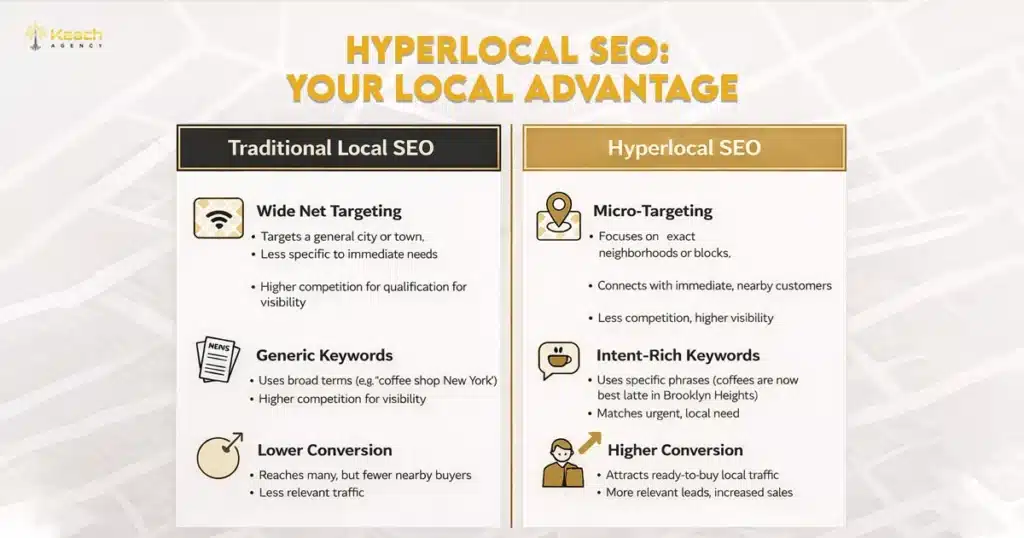
It’s the process of optimizing your business for extremely precise location searches, down to streets, blocks, and neighborhoods.
How is hyperlocal SEO different from local SEO?
Local SEO targets cities. Hyperlocal SEO targets micro-areas where customers are physically present.
Do I still need Google Maps optimization?
Yes, but it isn’t enough anymore. Customers also search on social platforms, local apps, and AI tools.
What are hyperlocal keywords?
Keywords that target tiny zones.
Can hyperlocal SEO increase sales?
Absolutely. Hyperlocal searches come from people who are ready to buy right now, which leads to much higher conversions.