
Search used to feel simple. You typed something into Google. You clicked a blue link. That was the whole story.
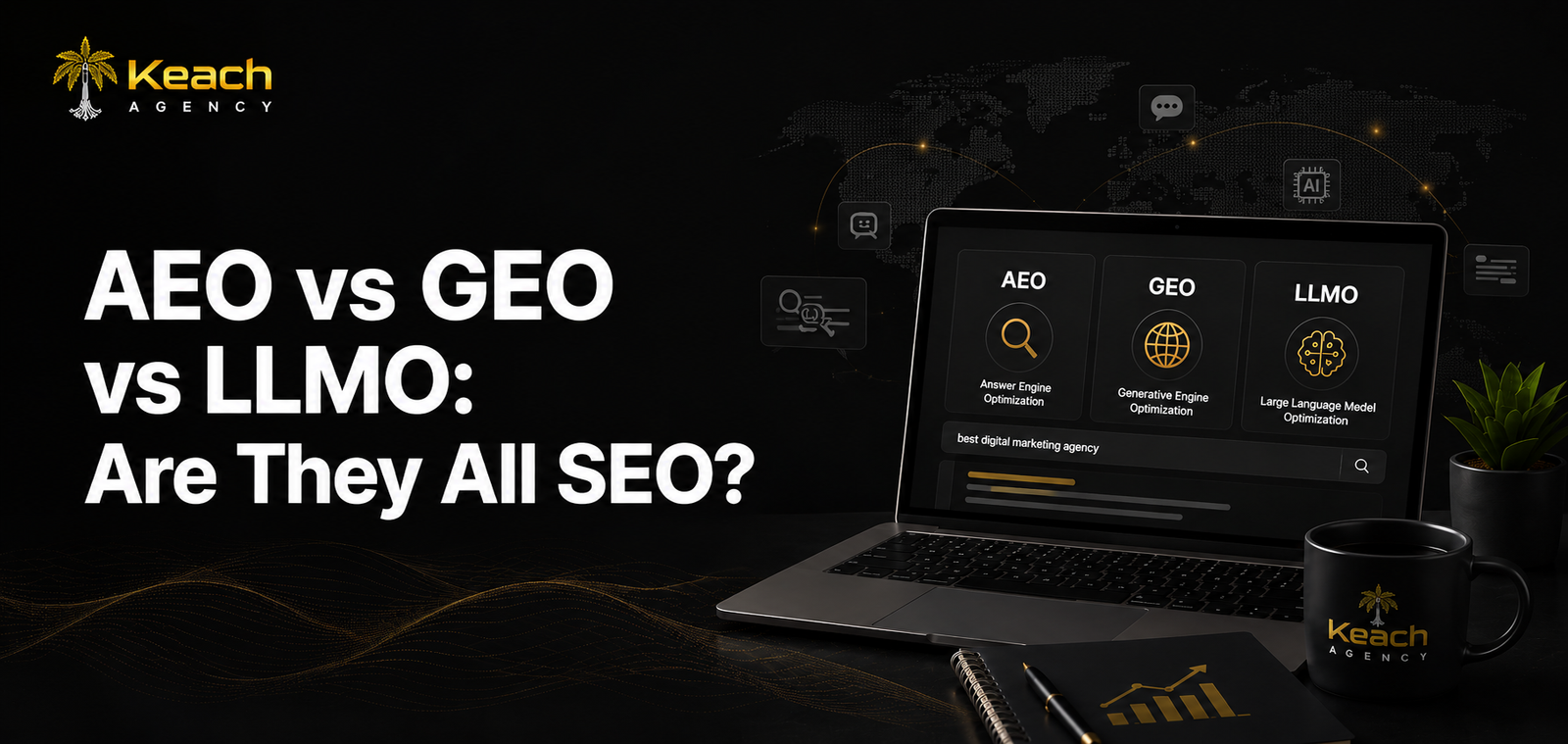
Now things look very different. Answers appear instantly. AI tools generate responses. Search engines behave less like directories and more like assistants. This shift has introduced a wave of new terms that confuse even experienced marketers: AEO vs GEO vs LLMO.
At first glance, they sound like buzzwords. Different labels for the same old practice. But they actually point to real changes in how information is discovered, ranked, and presented.
Before deciding whether they are just variations of search engine optimization, Keach’s Marketing Services helps to understand what problem each one tries to solve.
Feeling lost with all the new SEO terms?
Keach Agency helps in the clarity of modern search.
Why These New Terms Even Exist
Traditional search engine optimization focused on rankings.
- You optimized pages.
- Search engines indexed them.
- Users clicked results.
That model assumed people actively browse lists of links. But user behavior has shifted. Many people now expect direct answers instead of multiple choices. AI systems, featured snippets, and voice search all support this preference.
This is where AI SEO enters the picture.
Instead of optimizing only for crawlers, creators now think about how machines interpret meaning, context, and intent. The goal is no longer just “rank higher.” It is “be selected as the answer.”
That subtle difference is what gave rise to AEO vs GEO vs LLMO. Each one highlights a different layer of the same ecosystem. This evolution closely mirrors how search intent itself is evolving alongside AI-powered algorithms.
AEO: Answer Engine Optimization
Answer Engine Optimization revolves around one idea.
Visibility without clicks.
Modern search results often display answers directly on the results page. Featured snippets, knowledge panels, and AI summaries reduce the need to open websites. Content either becomes the chosen source or disappears into the background.
AEO focuses on structure and clarity:
- Clear definitions.
- Concise explanations.
- Well-formatted information.
Machines prefer content that removes ambiguity. Lists, tables, and direct responses increase the probability of selection.
Example:
- A vague paragraph may rank.
- A precise answer may be extracted.
That distinction matters more than ever in AI SEO strategies.
GEO: Generative Engine Optimization
Generative Engine Optimization emerged alongside AI-driven search systems.
Instead of showing static results, generative engines synthesize responses from multiple sources. Content is not merely displayed. It is interpreted, combined, and rephrased.
This introduces a new challenge. Influencing generated narratives.
GEO considers how AI systems build responses. The emphasis shifts toward topical authority, consistency, and semantic relationships rather than isolated keywords.
In simple terms, GEO asks:
When AI explains a topic, does your knowledge shape the answer?
That requires deeper coverage and contextual relevance. Thin pages struggle. Cohesive information clusters perform better. These are considered advanced techniques, yet they align with long-standing quality principles.
LLMO: Large Language Model Optimization
LLMO pushes the concept further.
Large language models do not rank pages like search engines. They predict language based on patterns learned from vast datasets. Optimization here is less about visibility inside results and more about influence over responses.
LLMO centers on three factors:
- Consistency of information.
- Clarity of language.
- Authority of source signals.
Unlike conventional search engine optimization, LLMO is probabilistic. There is no guaranteed ranking position. Instead, content increases its chances of being reflected in AI-generated outputs.
This again overlaps with AI SEO, though the mechanics differ. Strengthening brand mentions across the web also improves AI search visibility, since language models rely heavily on consistent, repeated signals.
Struggling to adapt content for AI-driven search?
Keach Agency is here for future-ready content.
Are They Actually Different From SEO?
This is the real question behind AEO vs GEO vs LLMO.
Technically, yes. Practically, not entirely.
All three rely on the same foundations:
- Relevance.
- Accuracy.
- Structure.
- User intent.
What changes is the retrieval mechanism
- Search engines rank.
- Answer engines extract.
- Generative engines synthesize.
- Language models predict.
From a strategy perspective, they represent evolving expressions of search engine optimization, not separate disciplines.
- Remove SEO; the system lacks discoverable sources.
- Remove AEO; answers become inconsistent.
- Remove GEO; AI summaries weaken.
- Remove LLMO; considerations and generated language drifts.
Why This Matters For Content Creators
Creators sometimes chase terminology instead of fundamentals. But machines still reward the same traits humans value:
- Clear explanations.
- Logical organization.
- Credible information.
Many so-called advanced techniques simply reinforce good writing habits. Clean structure improves both readability and machine interpretation. Precision benefits users and AI systems alike. This is also why building expert authority matters as much in the age of AI as it always did for traditional rankings.
That is why AI SEO is less about tricking algorithms and more about reducing confusion.
The Hidden Risk of Ignoring These Shifts
Ignoring AEO, GEO, and LLMO does not break visibility overnight. But over time, content may lose presence inside answers, summaries, and AI interfaces. Traffic patterns already show this transition. Fewer clicks. More direct responses.
Being absent from generated answers often means being invisible to users who never browse beyond them.
Understanding AEO vs GEO vs LLMO, therefore, becomes a defensive move, not a trendy experiment.
The Core Principle That Never Changed
Despite new labels, the underlying rule stays constant. Help the user. Not the crawler. Not the AI. Not the system. Clear thinking produces clear content. Clear content performs well across search engines, answer engines, and language models. This is precisely why combining AI tools with human expertise continues to outperform either approach alone.
Want content that survives every search evolution?
Advanced techniques improve AI SEO performance.
FAQs
What is the main difference between AEO, GEO, and LLMO?
AEO concentrates on becoming the selected answer within search interfaces. GEO focuses on shaping AI-generated summaries created from multiple sources. LLMO relates to influencing how large language models produce responses. While they differ in mechanics, they share the same informational foundations.
Does traditional search engine optimization still matter?
Yes. Indexing and discoverability remain essential. AI systems still depend on structured, accessible content sources. Without strong search engine optimization, visibility opportunities inside answer engines and generative systems decrease significantly.
Are these approaches considered AI SEO strategies?
In many contexts, yes. AI SEO acts as an umbrella concept describing practices that align content with machine interpretation and AI-driven retrieval. AEO, GEO, and LLMO each address different aspects of this interaction.
Do advanced techniques guarantee better rankings or answers?
No method guarantees outcomes. Search and AI systems operate probabilistically. Advanced techniques primarily increase clarity, contextual relevance, and interpretability, which improves the likelihood of selection or inclusion rather than ensuring it.
Should businesses change their entire SEO strategy because of AI?
Usually not. The strongest strategies integrate new considerations while preserving proven fundamentals. Clear information architecture, useful content, and relevance remain central across both traditional search engine optimization and AI-driven systems.