

If you’re running campaigns across multiple platforms in 2026: Google Ads, Instagram, TikTok, email, SEO, you already know the biggest headache:
Which channel is actually driving conversions?
This is where marketing attribution comes to the rescue. It tells you which touchpoints deserve credit, which channels are wasting budget, and where you should double down to grow faster.
In today’s world of data-driven marketing, attribution isn’t just a nice-to-have; it’s your secret weapon for smarter decisions, clear reporting, and a higher ROI.
In this blog, we’ll break attribution down, compare the most popular models, and help you figure out which one fits your business like a glove.
Want Us To Build A Perfect Attribution Model For Your Business?
We’ll set up GA4, map touchpoints, and deliver clear dashboards.
What Is Marketing Attribution?
Simply put, marketing attribution tells you which channel, ad, or interaction played a role in converting a user.
For example:
A customer discovers your brand on TikTok = sees a retargeting ad = searches your website = finally buys.
Who gets the credit?
TikTok? The retargeting ad? Google Search?
Attribution models are the judge that answers that question.
Want to improve your online marketing or strengthen your digital presence? Check out our Digital Marketing Services.
Why Attribution Matters In 2026
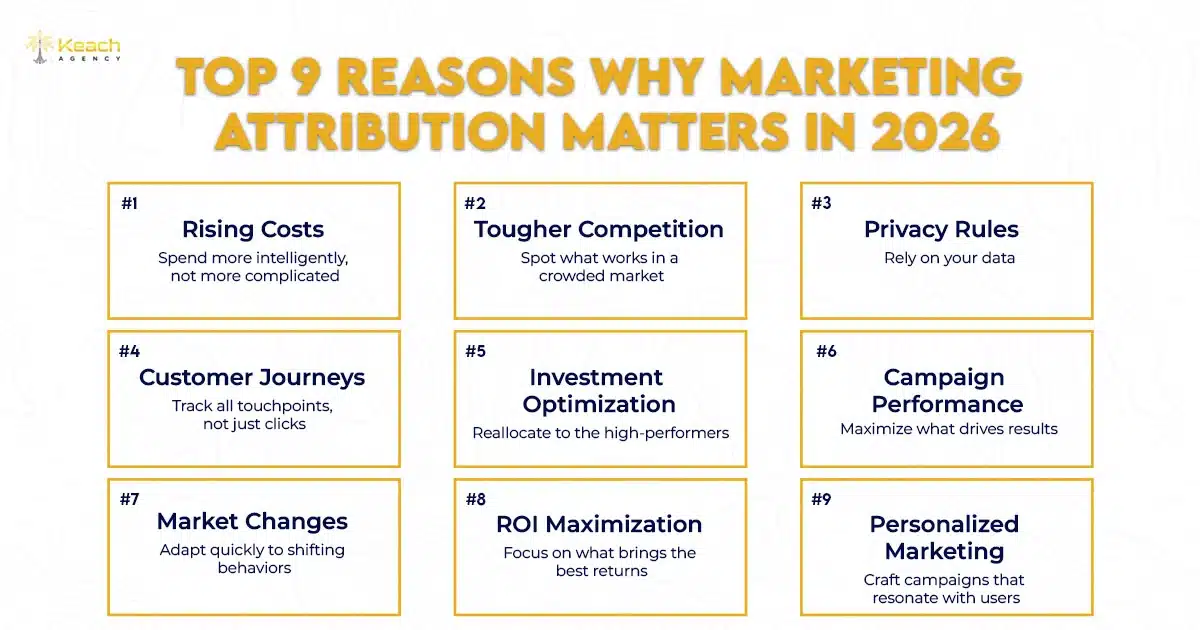
People don’t just click “buy” immediately anymore. The average customer touches your brand 7–10 times before deciding.
Attribution helps you:
- See which campaigns actually move the needle.
- Stop wasting budget on channels that aren’t performing.
- Improve the overall customer experience.
- Get accurate ROI numbers.
- Make smarter, data-driven decisions.
- Optimize every stage of your marketing funnel.
Want the full picture? Check out our “Data-Driven Marketing Mastery” blog to build a complete analytics strategy.
The 5 Most Important Attribution Models (Made Simple)
Here’s a quick, friendly breakdown of the models you need to know:
1. First-Touch Attribution
What it does: Gives 100% credit to the first interaction.
Example: Someone finds your business through an Instagram Reel, and later buys via Google. Instagram gets all the credit.
Best for: Brand awareness campaigns. Perfect if you want to know which channels bring in fresh eyes.
2. Last-Touch Attribution
What it does: Gives all the credit to the last interaction before the purchase.
Example: A user sees your TikTok = Google ad = email = purchase. Email gets all the glory.
Best for: Small funnels or simple customer journeys. Great if you just want a quick answer.
Need Help Making Sense Of Your Multi-Channel Data?
Our analytics experts can highlight what’s actually working.
3. Linear Attribution
What it does: Splits credit evenly across all touchpoints.
Example: Facebook = Website = Email = Purchase. Each gets 25% credit.
Best for: Businesses with long, multi-step customer journeys.
4. Time-Decay Attribution
What it does: Gives more credit to touchpoints closer to the conversion.
Example: Google ad = Email = SMS = Purchase. SMS gets the most credit.
Best for: Products with a quick decision cycle.
5. Data-Driven Attribution (DDA), Most Accurate
What it does: Uses machine learning to assign credit based on real user behavior.
Example: GA4 notices that email usually triggers the purchase so email gets higher credit automatically.
Best for: Any business running multi-channel campaigns with GA4.
Track attribution like a pro with our “Mastering Google Analytics 4” blog.
How To Choose The Right Attribution Model
- Simplicity: Last-touch, quick answers for small teams.
- Awareness insights: First-touch, see which channels bring in new audiences.
- Long journeys: Linear or Time-decay, optimize the full funnel.
- Accuracy: Data-driven, best for GA4 users with multi-channel campaigns.
- Multiple platforms: DDA + GA4, get the clearest ROI picture
Attribution + GA4 = A Match Made In Heaven
GA4 doesn’t just track conversions, it helps you see:
- Which ad campaigns drive revenue?
- Which channels assist conversions?
- Which touchpoints appear most in converting paths?
- Where customers drop off.
- Which platforms bring your highest-value users?
Combine GA4 with the right attribution model, and suddenly, your marketing data makes sense.
Common Attribution Mistakes (and How To Avoid Them)
- Relying on just one model: not every campaign fits the same model.
- Ignoring assisted conversions: just because it’s not last-click doesn’t mean it’s not valuable.
- Tracking the wrong events: GA4 setup matters.
- Not aligning with goals: awareness vs. conversion campaigns need different approaches.
- Not testing models: experimenting gives clearer data.
Ready To Boost ROI With Smarter Attribution?
Let us optimize your marketing performance.
FAQs
Which attribution model is the best?
Data-driven attribution is the most accurate, especially with GA4.
Do small businesses need attribution?
Yes! Even small campaigns benefit from knowing which channels convert.
How does GA4 handle attribution?
GA4 uses data-driven attribution and compares all touchpoints across channels.
Can I switch models anytime?
Absolutely. Test different ones depending on your campaign goals.
Why is attribution important for marketers?
It helps avoid wasted ad spend, improve targeting, and maximize ROI.