
In 2026, businesses aren’t just using data; they’re built on it. Marketing has officially shifted from intuition-led decisions to insight-driven strategies, and the brands winning today are the ones that know how to get real value from their data.
This is the era of data-driven marketing, where analytics isn’t something you check at the end of a campaign. It’s the engine that powers every move you make.
From optimizing campaigns to refining audience segments to improving customer journeys, success now depends on more than creative instincts. It requires real-time insights, measurable metrics, and predictive analytics that help you make decisions perfectly.
And as customer behavior becomes more integrated across apps, platforms, and devices, the brands that can unify and analyze data from every point will see the highest results.
This guide breaks down how to use analytics effectively, the tools that matter most in 2026, and how you can systematically improve ROI with a data-driven marketing strategy, even if your business is still in the transformation phase.
Ready To Build A High-ROI Marketing Strategy?
Get a complete data-driven marketing audit tailored to your business.
Need expert help turning analytics into real revenue? Explore our full marketing services at Keach Agency.
Why Data-Driven Marketing Matters More Than Ever In 2026
Today’s customers leave digital footprints everywhere:
- Social media.
- Email.
- Websites.
- Mobile apps.
- Search engines.
- Smart devices.
- Offline-to-online interactions.
Every point tells you:
- What people want.
- When they’re ready to buy.
- What influences their decisions?
- How they behave across platforms.
- Why do they convert?
This gives marketers something they’ve never had before.
Predictability
You no longer need to guess:
- Which content works?
- Which channels are profitable?
- Who are your best customers?
Data gives you the clarity and confidence to manage budgets smarter, build targeted campaigns, and improve results consistently.
Building A High-Performance Data-Driven Marketing Strategy
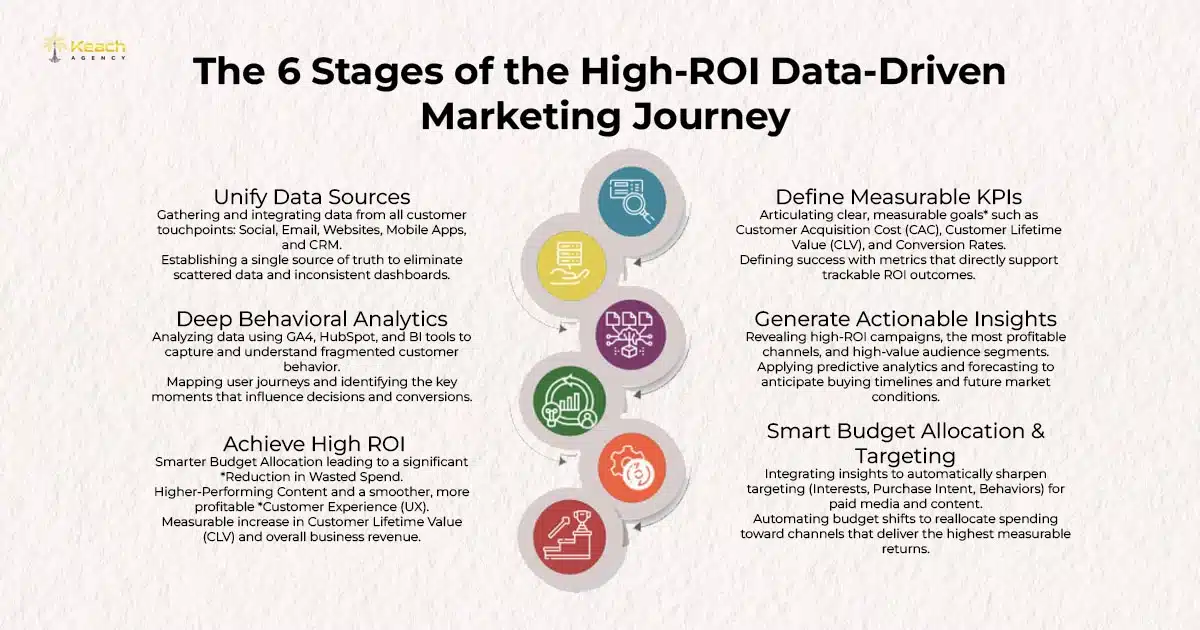
A strong strategy isn’t about collecting more data; it’s about collecting the right data and knowing what to do with it.
Here are the essentials:
1. Clear KPIs and measurable goals
You can’t optimize what you can’t measure.
Define success with metrics like:
- Customer acquisition cost (CAC).
- Conversion rates.
- Customer lifetime value (CLV).
- Engagement depth.
- Retention metrics.
Your analytics must support trackable outcomes.
2. Unified data sources
In 2026, top-performing brands rely on a centralized data system, whether that’s a CRM, CDP, analytics suite, or integrated technological stack.
No more:
- Scattered data.
- Inconsistent dashboards.
- Guesswork because information lives in different places.
Everything flows into one source of truth.
3. Insights that drive decisions (not just dashboards)
Dashboards are information. Insights are action.
You need visibility into:
- Which campaigns drive the highest ROI?
- Which channels bring the most qualified leads?
- Which demographics convert best?
- What messaging resonates most?
Analytics should tell you not just what happened, but what to do next.
4. Predictive analytics and forecasting
AI-powered analytics now help you anticipate:
- Customer numbers.
- Buying timelines.
- Trending topics.
- High-value audience segments.
- Future market conditions.
Predictive modeling turns marketing analytics tools into future revenue.
Want To Unlock Insights Hiding Inside Your Analytics Tools?
We’ll optimize your dashboards and reporting.
Best Marketing Analytics Tools For 2026
Not every tool is built for the level of insight modern marketers need.
Here are the platforms that truly matter:
Google Analytics 4 (GA4)
Event-based tracking, cross-channel attribution, and user behavior insights.
HubSpot Marketing Hub
Unified CRM data, automated reporting, and campaign analytics.
Tableau / Power BI
Advanced visualization and strategic business intelligence.
Mixpanel
Deep behavioral analytics and user journey mapping.
Together, these marketing analytics tools help you move from guesswork to precision.
How Data Directly Improves Marketing ROI
A data-driven marketing strategy makes every marketing dollar work harder. This is where improving marketing ROI with data becomes an absolute game-changer.
1. Better audience targeting
Instead of broad targeting, analytics reveal:
- Interests.
- Behaviors.
- Demographics.
- Purchase intent.
- Affinities.
Your paid ads, email automation, and content reach people who are actually ready to convert.
2. Smarter budget allocation
Analytics show you:
- Which campaigns deserve more spending?
- Which channels to cut?
- Where are your best returns coming from?
No more wasted budget or random experimentation.
3. Higher-performing content
Data helps you understand:
- Top-performing formats.
- High-converting topics.
- Best posting times.
- CTA performance.
Every piece of content becomes intentional and more profitable.
4. A smoother, more profitable customer experience
Analytics highlight:
- UX friction points.
- Bounce moments.
- Personalization opportunities.
- Journeys.
Fixing these improves both conversions and long-term retention.
Need A Fully Integrated Data-Driven Marketing System?
Our team can set up your tracking, analytics, and automation from scratch.
FAQs
What is data-driven marketing?
A marketing approach where decisions are based on analytics and real data, not assumptions.
Why is data-driven marketing essential in 2026?
Because customer behavior is fragmented across channels, only data can reveal where conversions truly happen.
What tools do I need?
GA4, a CRM, a CDP, and BI tools like Power BI or Tableau for deeper insights.
How does data improve ROI?
It sharpens targeting, cuts wasted spend, identifies profitable channels, and improves the customer journey.
Can small businesses use data-driven marketing?
Absolutely. Even basic analytics tools can significantly improve decisions and conversions.