

Most marketers still think A/B testing means comparing two colors, two headlines, or two CTAs.
But in 2026, that mindset is outdated.
The brands winning today aren’t running occasional surface-level tests; they’ve built full experimentation systems that refine messaging, creative, and funnels every single day.
If you’ve read our blogs on Data-Driven Marketing Mastery or GA4 analytics, you already know the modern truth: Marketing isn’t about one-time insights anymore, it’s about continuous optimization.
Advanced A/B testing takes you far beyond the basics and turns experimentation into a revenue engine. In this guide, we’ll break down how advanced testing works, the frameworks high-performing brands use, and how you can turn every campaign into a constant source of growth.
Want Advanced Experimentation Built Into Your Marketing?
Explore our Data-Driven Marketing Services.
Why Traditional A/B Testing Isn’t Enough Anymore
Classic A/B testing still matters, but it has serious limitations:
- Only one variable at a time.
- Slow learning cycles.
- Surface-level data.
- High risk of false positives.
- Only happens after performance dips.
In 2026, that’s too slow and too expensive.
Today’s marketing environment demands:
- Faster experimentation.
- Real-time feedback loops.
- Multi-variable testing.
- Predictive insights.
- Personalization at scale.
That means moving beyond A/B basics into smarter, continuous experimentation.
Advanced A/B Testing Strategies You Should Be Using
1. Multivariate Testing (MVT)
Instead of testing one variable, MVT tests multiple elements and combinations at the same time.
For example:
- Headline + CTA + hero image.
- Layout + copy + button placement.
- Price + product title + review section.
You’re not just finding what works, you’re finding which combination works best.
Best for:
Websites or funnels with enough traffic to support multi-variable analysis.
2. Dynamic Personalization Testing
This is where testing meets real-time personalization. Instead of picking one “winner,” dynamic systems show different variations based on:
- User behavior.
- Device.
- Demographics.
- Traffic source.
- Purchase history.
Tools like Adobe Target, Optimizely, and AI-based personalization engines deliver optimized experiences automatically.
Read our Predictive Analytics and Effective Marketing Dashboards blogs to see how this intelligence fuels personalization at scale.
3. Multi-Armed Bandit Testing
Bandit testing eliminates the old-school 50/50 split. It automatically shifts more traffic toward the winning variation, in real time.
Benefits:
- Faster insights.
- Less wasted traffic.
- Lower cost per experiment.
- Higher chance of immediate wins.
Perfect when you can’t afford to “lose” traffic to underperforming variants.
4. Sequential Testing & Always-On Experiments
Instead of running one-off tests, sequential testing lets you:
- Run ongoing experiments.
- Learn continuously.
- Improve week after week.
Ideal for:
- E-commerce funnels.
- SaaS onboarding flows.
- Seasonal businesses.
- Sites with steady, high traffic.
This transforms optimization into a permanent performance engine, not a one-time project.
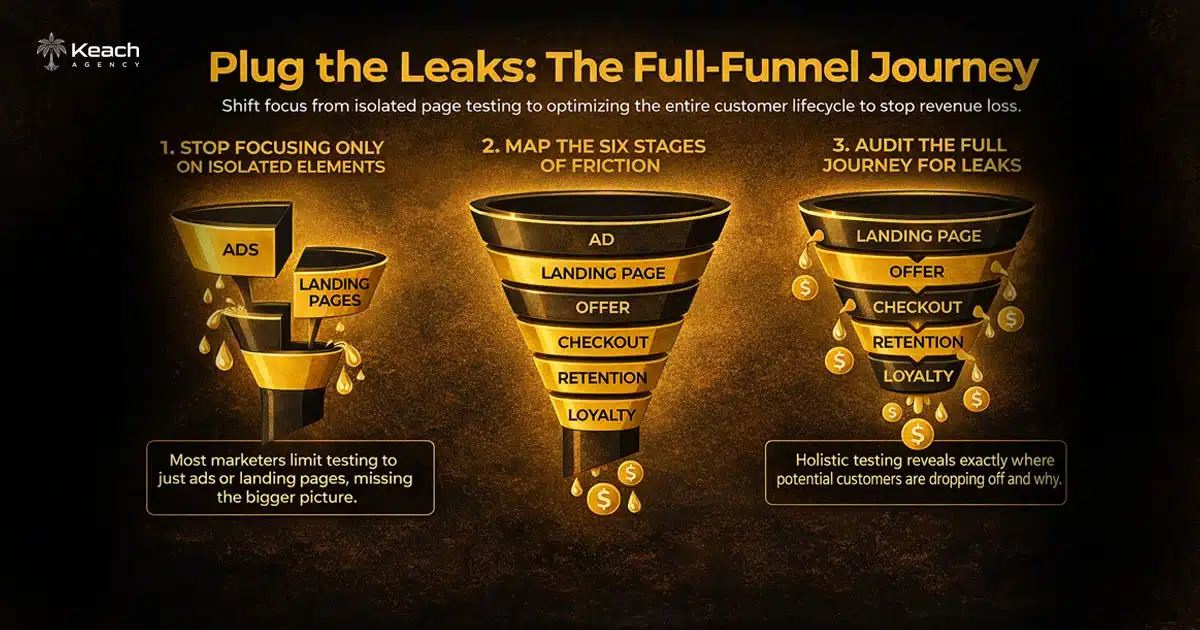
5. Full-Funnel Testing
Most marketers test ads or landing pages. But the biggest conversion losses are usually hidden across the entire journey:
Ad → Landing page → Offer → Checkout → Retention → Loyalty.
Testing across the full funnel shows where friction lives, and where revenue is leaking.
Need Stronger Analytics Foundations Before Testing?
Keach Agency is just a call away.
How To Build A Continuous Optimization System
Here’s how to evolve from simple A/B tests to a full experimentation engine:
Step 1: Define Your North Star KPIs
Conversion rate, ROAS, retention, ACV, whatever moves your business forward.
Step 2: Centralize Your Data
You need unified insights from:
- GA4.
- CRM.
- Ad platforms.
- Email.
- Heatmaps.
- Attribution tools.
Our GA4 guide shows how to set foundations properly.
Step 3: Use Experimentation Tools
Tools include:
- Optimizely.
- VWO.
- Convert.com.
- Adobe Target.
- Google Optimize alternatives.
Pick one based on traffic volume and complexity.
Step 4: Build a Testing Pipeline
Your roadmap should include:
- Weekly micro-tests (CTAs, headlines, ad variations).
- Monthly major experiments (layouts, offers, flows).
- Quarterly optimization deep dives (full funnel reviews).
This keeps your system moving; always learning, always optimizing.
Step 5: Automate What You Can
AI and predictive technologies can:
- Auto-adjust bids.
- Optimize creative delivery.
- Predict winning variants.
- Personalize user journeys.
These tie directly into our Predictive Analytics blog.
Step 6: Document Everything
A testing journal helps:
- Avoid duplicate experiments.
- Speed up learning.
- Build long-term optimization intelligence.
It becomes your team’s playbook.
Real Examples Of Advanced Optimization
E-commerce:
Multi-armed bandit tests adjusting product page layouts in real time.
SaaS:
Behavior-based onboarding paths tailored by dynamic personalization.
DTC brands:
Sequential testing for pricing, bundles, and shipping thresholds.
News & media:
MVT for headlines, hero images, and content formats.
Continuous experimentation = continuous growth.
Confused About Measurement And Attribution?
Keach Agency has just the right experts for you.
FAQs
Do I still need simple A/B tests?
Yes, great for quick wins. But advanced testing delivers deeper, scalable insights.
Is multivariate testing better than A/B testing?
Not always, it’s powerful but requires more traffic.
What if my website has low traffic?
Use bandit testing or sequential testing; both work with smaller datasets.
How long do advanced tests run?
Until statistical significance is reached, though AI can accelerate this.
Does GA4 support advanced testing?
GA4 doesn’t run experiments, but it provides the behavioral data you need to design smarter tests.